

Part 1
The china on my parents’ table only came out twice a year: Christmas and the kind of funeral where people wore black coats they hated and said polite things they didn’t mean. The plates were ivory with gold vines running along the edges, and my mother treated them like family heirlooms even though they’d been purchased on sale in the late nineties and never once washed by anyone but her.
She called it tradition. I called it theater.
Every year, she turned our dining room into a staged photograph—candlelight, place cards written in that careful looping handwriting she’d practiced for decades, sprigs of rosemary tucked under napkins like we were dining in a magazine. She had started “prepping” for Christmas in early November, which was her favorite way to remind everyone that love could be measured in effort, and effort could be used as a weapon.
“You don’t know how much work I do,” she would say, not looking for thanks so much as leverage.
When I pulled up to their house that night, snow crusted along the edges of the driveway, I sat in my car for a moment longer than necessary. My hands gripped the steering wheel while my son, Noah, leaned forward in the passenger seat, his breath fogging the window.
“Are we late?” he asked.
“No,” I lied. We were early. My mother hated when people were late, but she hated when I was early too because it took away her chance to imply I didn’t care. I never won. I had stopped trying to win years ago, but my body still held onto the habit of bracing.
Noah wore the sweater my mother had bought him the year before. Navy blue with a stitched reindeer on the front. She had selected it carefully, made a point of handing it to me in a bag with tissue paper, then later told my sister that it was too expensive for someone who didn’t appreciate it. My mother believed gifts were investments. When you accepted them, you agreed to a silent contract.
Noah didn’t know any of that. He just thought it was soft and that it made his grandmother smile. He wanted her to like him. Kids are like that. They want adults to love them so badly they’ll try to squeeze themselves into whatever shape they think love requires.
I opened the door, and the smell of roasted turkey, cinnamon, and my mother’s perfume hit me all at once. The house was warm in the way that made your cheeks sting. My mother’s voice carried from the kitchen—bright, sharp, practiced. Laughing at something my aunt said. There were already too many shoes near the entryway and too many coats in the closet. The family had gathered. The audience was seated.
Noah took my hand. His palm was small, his fingers slightly sticky from the candy cane he’d been sucking in the car. He squeezed, and I squeezed back.
My mother appeared almost immediately, as if she’d been waiting behind a curtain. She wore a deep green dress and earrings shaped like tiny stars. She kissed my cheek, barely. Her eyes flicked over me—my hair, my jacket, my shoes—cataloging faults before she even said hello.
“You made it,” she said, the tone implying she’d been unsure.
“Hi, Mom,” I said. “Merry Christmas.”
“Merry Christmas,” she repeated, and then her gaze shifted to Noah. Her smile warmed a few degrees. Not because she loved him more than she loved me. Because he was an extension of her, in her mind. A grandchild was proof she’d done something right.
She pinched his cheek. “Look at you,” she said. “So handsome. And you wore the sweater.”
Noah beamed. “It’s my favorite,” he said, honest.
My mother’s smile widened, proud of her own purchase. “Of course it is,” she said, as if his opinion existed solely to confirm hers.
We moved into the dining room. The table was already set, and the center held a red tin of sugar cookies dusted with powdered sugar, the kind my mother only made once a year. She treated them like sacred offerings. They weren’t just cookies. They were proof she was a good mother, a good hostess, the woman who kept everyone fed and together. She had a story for every batch—how her grandmother made them, how she perfected the recipe, how no one appreciated the time it took.
My sister, Leah, sat across from me. She wore lipstick the exact shade my mother liked and had her hair curled the way my mother complimented. Leah knew how to be rewarded. She’d learned early that the easiest way to survive in our family was to align with the person holding the power.
My father sat at the head of the table, carving turkey with the calm precision of a man who liked sharp tools and clean lines. He owned a construction supply business that he referred to as “the company,” as if it were a living thing. The company had been his pride, his excuse, his altar. He boasted about it at family gatherings and blamed it for his absence at everything else.
“Sit,” my father said when Noah and I hesitated, and it was less invitation than command. Like he was talking to employees and not family.
Noah climbed into his chair. His legs swung because the seat was too high. He rested his hands in his lap the way I’d taught him, polite, small, careful.
Dinner began like it always did. My mother narrated the meal as if she were hosting a cooking show. She explained how long the turkey cooked and how she basted it every thirty minutes and how she almost didn’t make the cranberry sauce because no one ever ate it. My aunt laughed in the right places. My sister complimented my mother’s presentation. My father nodded, chewing, listening only enough to confirm he didn’t have to do anything.
I tried to keep my face neutral. I tried to keep my voice light. I tried to keep the evening from becoming one of those nights where I drove home replaying every sentence I said, wondering which one would be used against me later.
Noah stayed quiet, which was unusual. He was talkative at school, according to his teacher. At home, he told me detailed stories about his day that started with a dinosaur and ended with a question about why the moon followed our car. But at my parents’ house, he shrank. He watched more than he spoke. His eyes moved like he was trying to map invisible rules.
Halfway through dinner, his gaze drifted to the cookies. He stared at the red tin like it was a treasure chest. He leaned toward me and whispered, “Mom, can I have one?”
I glanced toward my mother. The cookies sat in the middle of the table, right within reach, but I knew better than to assume. My mother’s “help yourself” always came with conditions.
“They’re right there,” I whispered back. “Go ahead.”
Noah reached out slowly, carefully, like he didn’t want to disturb the air.
Smack.
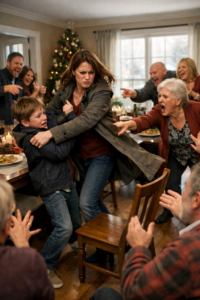
The sound wasn’t thunderous, but it was sharp enough to slice the conversation in half. My mother slapped his hand away. Not hard enough to bruise, but hard enough to send the message: you do not take what you have not been granted.
Noah froze. His fingers curled in the air and then pulled back to his lap. His face went blank—no tears, no anger, just confusion. The kind of confusion that lives in children when cruelty comes wrapped in a smile.
My mother laughed. She actually laughed.
“Oh no,” she said brightly, waving her hand as if shooing a fly. “Those are for the good grandkids. Not for you.”
For a moment, the room held its breath. Then someone laughed. Then another. My sister snorted into her wine glass as if it were the funniest thing she’d ever heard. My aunt smiled awkwardly, eyes flicking between me and the tin of cookies like she wanted to disappear.
My father kept carving turkey. He didn’t look up. He didn’t pause. He didn’t say a word.
Noah stared at the table. His shoulders curled inward. He folded his hands tightly together, as if holding them in place would keep them from reaching for anything else he wasn’t allowed to have.
The air in my chest tightened. But my mind did something strange. It cleared.
It wasn’t just the cookie. It wasn’t even just my mother’s words. It was the feeling of watching the whole room accept her cruelty as entertainment. It was the way no one corrected her. It was the way my father’s silence felt like permission.
It was the memory of being nine years old, asking for a second helping of mashed potatoes, and my mother saying, loudly, “Someone’s hungry today, aren’t they,” while everyone laughed as if humiliation was a family sport.
It was being sixteen, crying in my room after a breakup, and my father telling me I needed to “toughen up” because no one had time for drama.
It was being twenty-four, paying off my college loans alone because the money my parents promised “was coming” never arrived.
It was being thirty-two, agreeing to cover a business loan “just for a few months” because my father insisted the company needed support and family helps family.
It was all of it, stacked like plates, balanced precariously, waiting for one small impact.
Noah’s small hand had reached for a cookie, and my mother had slapped it away like he was a dog begging under the table.
Something inside me went still.
I stood up.
I didn’t slam my chair. I didn’t raise my voice. I didn’t give my mother the reaction she’d later twist into a story about how unstable I was. I simply reached behind Noah’s chair, grabbed his coat, and helped him into it.
“We’re leaving,” I said.
The room went quiet for a heartbeat. Then the noise returned, frantic, defensive.
“Oh, come on,” my mother said. “Don’t be dramatic.”
“It was a joke,” my sister added, rolling her eyes.
My aunt said, “Let’s not ruin Christmas.”
I looked at my mother, calm enough that my voice sounded like someone else’s. “You already did.”
My father finally looked up. His eyes narrowed. “Sit down,” he said, the same tone he used when an employee was late to a job site.
I didn’t answer. I took Noah’s hand. His fingers were cold. We walked out without saying goodbye.
Outside, the cold air hit us hard. The driveway was lined with little snowdrifts. Christmas lights glowed along the roofline, blinking cheerfully, completely unrelated to what had happened inside.
We walked to the car in silence. Halfway there, Noah looked up at me.
“Mom,” he asked quietly, so quietly it almost broke me. “Was I bad?”
The question stabbed deeper than my mother’s slap.
I knelt down right there in the driveway, snow seeping into the knees of my jeans. I cupped his face with my hands and made him look at me.
“No,” I said. “Noah, you are not bad. You’re good. You’re kind. You didn’t do anything wrong.”
He blinked. His eyes searched mine, trying to decide whether he could trust the words.
“Grandma said…” he started.
“I know what she said,” I interrupted gently. “Grandma was wrong.”
“But… the room laughed.”
I swallowed. “Sometimes adults laugh when they’re uncomfortable,” I said, choosing the simplest truth he could carry. “Sometimes they laugh because they don’t want to stand up. But that doesn’t mean you deserved it.”
Noah nodded slowly. He didn’t fully believe me yet, but he wanted to. That was the part that made my throat ache.
We drove home. Snow fell lightly on the windshield. The radio played cheerful songs about warmth and family and togetherness, and every lyric felt like a lie.
When we got home, I tucked Noah into bed. He asked if Santa would still come even though we left Grandma’s. I told him Santa wasn’t keeping score like that. I kissed his forehead, turned off the light, and sat on the edge of the bed for a moment, listening to his breathing slow.
Then I went into the kitchen and stared at my phone.
At 11:47 p.m., it buzzed.
My dad: Don’t forget the business loan payment tomorrow.
I stared at the screen for a long time. My thumb hovered over the keyboard.
I thought about my mother’s hand slapping my son’s. I thought about my father’s eyes when he told me to sit down. I thought about the way they had taken my money for years like it was owed.
And I finally understood something that should have been obvious long ago.
They didn’t think I would ever leave. Not really. Not in a way that cost them.
I typed my reply slowly, deliberately.
Already handled. I’m pulling out. Effective immediately.
I hit send.
Then I flipped the phone face down on the counter and took a deep breath.
I didn’t know it yet, but that single sentence was the first crack in the empire my parents had built—not the business empire, but the family one. The one where love was conditional, obedience was currency, and I was expected to pay endlessly for a seat at the table.
That night, I fell asleep with my son safe in the next room, and for the first time in years, I felt calm.
Not peaceful.
Calm, like the air right after a storm, when the world is quiet because everything has shifted and there’s no going back.
