Editor

Editor

Her Husband Didn't Know her Nanny Cam Was Still On When she Left For Work; And What she Discovered The first thing Simone noticed when she opened the app on her phone was the time stamp. 9:47 a.m. She had left for work at 8:30 that morning, kissed Derrick goodbye like she did every day, and told him she loved him. He had smiled at her, that same smile she'd fallen in love with 7 years ago, and said he'd see her tonight. She'd walked out the door with her coffee in hand, believing she had a normal, happy marriage. now sitting in her car in the parking garage at 3:00 p.m. after a meeting got cancelled. She was scrolling through the nanny cam footage out of boredom. They didn't have children yet, but she'd installed the cameras 2 years ago after a break-in on their street. Dererick knew about them. They both checked them sometimes when they were away from home. Made them feel safe, but Dererick must have forgotten about the one in the bedroom. Or maybe he thought Simone would never check it. Or maybe he just didn't care anymore. At 9:47 a.m., the bedroom door opened. Dererick walked in, but he wasn't alone. A woman followed him. A woman with long brown hair wearing a tight red dress. A woman who was laughing at something Dererick had said. A woman who reached for Dererick's hand and pulled him toward the bed. Their bed. The bed with the blue comforter Simone had picked out last spring. The bed where she slept every single night next to the man she trusted with her whole heart. Simone's hand started shaking so badly she almost dropped her phone. She wanted to stop watching, wanted to close the app and pretend she'd never seen it. But she couldn't. She sat frozen in her car, watching her husband kiss another woman, watching him unzip that red dress. Watching him lay this stranger down on their bed, watching him betray every promise he'd ever made to her. The footage was clear, too clear. She could see everything. The way he touched this woman, the way he smiled at her, the way he looked at her with the same desire he used to show Simone. Or maybe he still showed Simone that look, but it was a lie now. Everything was a lie. Simone watched for 23 minutes. 23 minutes that destroyed her entire world. When it was over, when Dererick and the woman got dressed and left the bedroom, Simone finally moved. She gasped for air like she'd been drowning. Her chest hurt. Her stomach hurt. Everything hurt. She wanted to scream. She wanted to drive home right now and confront him. She wanted to call him and curse him out. She wanted to know who this woman was, how long this had been going on, why he would do this to her. But instead, she sat in her car in the parking garage and cried silently for 10 minutes. Then she stopped crying. She wiped her face. She fixed her makeup using the mirror on her son visor and she went back to scrolling through the footage. This happened today. Maybe it had happened before. Maybe there was more. She needed to know everything before she did anything. She went back one week. Same thing. 9:52 a.m. Derek and the same woman in their bedroom on their bed acting like Simone didn't exist, like their marriage didn't exist. Like seven years of love and trust and promises meant nothing. Two weeks back again, same woman, same bed, same betrayal. Simone went back through two months of footage. It happened every single week, sometimes twice a week, always in the morning after Simone left for work. Always the same woman. Dererick had been doing this for months, right under her nose, in her own home, in her own bed. She felt sick. She rolled down her car window and breathed in the cool air, trying not to throw up. Her phone buzzed with a text message. She looked down at the screen. It was from Derek. Hey babe, what do you want for dinner tonight? I can pick something up on my way home. Love you. Love you. The words made her want to throw her phone across the parking garage. How dare he say that to her? How dare he act like everything was normal? How dare he lie so easily. Her hands moved across the phone screen before her brain could catch up. She typed back, "Anything is fine. Love you, too." She hit send and immediately felt disgusted with herself. But she couldn't let him know that she knew. Not yet. She needed time to think, time to plan, time to figure out what to do next. Simone sat in her car for another 30 minutes thinking. She was a smart woman. She had a successful career in commercial real estate. She made good money. She was independent and strong. But right now Voir moins

Her Husband Didn’t Know her Nanny Cam Was Still On When she Left For Work; And What she Discovered

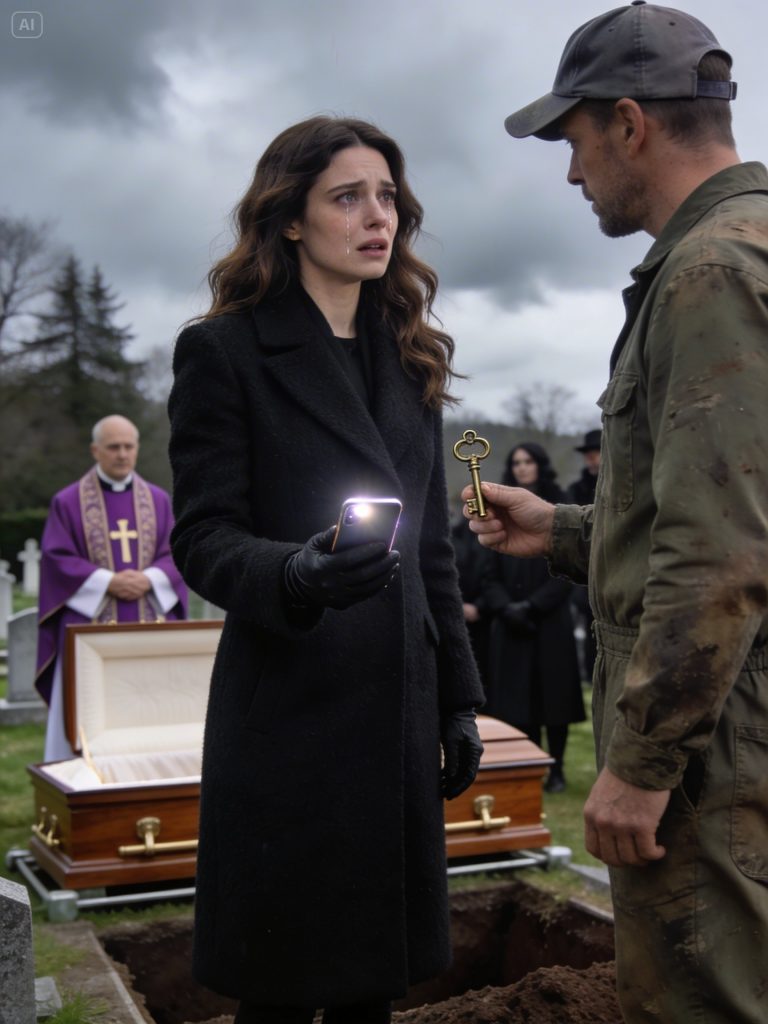
At my mother’s funeral, the last thing I expected was for the gravedigger to step away from the crowd, pull off his gloves, and motion for me to come closer as if we were discussing some quiet family matter. His name tag read Earl, and his face looked older than the cemetery itself. He kept his voice low. “Ma’am,” he said, glancing toward the casket, “your mom paid me to bury an empty coffin.” I stared at him, convinced grief had made me hear wrong. “Stop fooling around.” Earl didn’t smile. Instead, he slipped something cold into my hand. A brass key. Tiny black numbers were stamped on the metal tag attached to it: 16. “Don’t go home,” he whispered. “Go to Unit 16. Right now.” Before I could ask what he meant, my phone buzzed. I looked down and felt my stomach twist. A message from Mom appeared on the screen. Come home alone. My mother had been dead for six days. I had personally identified her body at St. Joseph’s. I had signed the insurance forms. I had spent the morning shaking hands with people who kept telling me she was in a better place. And now her name glowed on my phone as if she had simply gone out for groceries. I looked up, but Earl was already walking back toward the grave. The pastor continued speaking. My aunt Linda cried into a tissue. No one else seemed to notice anything unusual. I should have told someone. Instead, I slipped the key into my purse, walked to my car, and drove away from my own mother’s burial before the first shovel of dirt touched the coffin. Unit 16 was located at a storage facility on the outskirts of town, twenty minutes from the cemetery and about a mile from the interstate. The place looked nearly deserted—just long rows of metal doors and a flickering office sign that read SAFELOCK STORAGE. My hands shook so badly I dropped the key twice before finally getting it into the lock. When the lock clicked open, I lifted the door about three feet and froze. Inside there was no furniture. No boxes. No old winter coats. Instead, there was a folding chair, a lantern, three gallons of water, a legal file box, and sitting on the chair was my mother’s navy-blue handbag—the same one she had supposedly been carrying the night she died. An envelope was taped to the purse with my name written across it in her handwriting. For Emily. If you’re reading this, they lied to you first. And just as I reached for it, I heard tires crunch behind me… To be continued in comments 👇 Voir moins

At my mother’s funeral, the last thing I expected was for the gravedigger to quietly step away from the group, peel off his gloves, and motion for me to come…

You’re digging through a book lover’s raffle basket—expecting maybe a chipped mug or a paperback you’ve already read—and then you see it: a small, carved wooden object shaped like a fox… or a bat… or possibly a tiny throne for your thumb. At first, you’re confused. Is this a knuckle duster? A paperweight? Then it clicks. It’s a thumb book holder—and suddenly, you’re transported back to late-night dorm rooms, crowded subways, and reading in bed with one hand under the covers and the other clutching a novel like a lifeline. 📚 What Is a Thumb Book Holder? A thumb book holder (sometimes called a “book ring” or “reading ring”) is a simple, often hand-carved wooden or metal ring with a hole in the center. You slide your thumb through it, grip your book from the bottom spine, and—just like that—your book stays open, steady, and perfectly angled… with one hand. No more wrestling with stiff spines. No more losing your page to a breeze. No more awkwardly wedging a hardcover between your knees. It’s minimalist design at its most functional—and deeply nostalgic. 💭 Why It Feels Like Time Travel In an age of glowing screens and infinite digital libraries, the thumb book holder is a relic of tactile reading—a time when books were objects to be held, smelled, dog-eared, and loved. continued on next page

It reminds us of:

Au petit-déjeuner, au moment où j'ai refusé de donner ma carte de crédit à sa sœur, mon mari m'a jeté du café en pleine tête et a aboyé : « Plus tard, elle vient à la maison. Donne-lui tes affaires ou va-t'en ! ” Tremblant de douleur, de rage et d'incrédulité, j'ai emballé tout ce que je possédais et laissé. Alors quand il est finalement revenu avec sa sœur, il s'est figé en pleine merde à ce qui l'attendait...... Mon mari, Ryan, a jeté le café avant même que je comprenne qu'on se battait. Une seconde, j'étais debout au comptoir de la cuisine de notre maison en ville à l'extérieur de Columbus, j'ai glissé des œufs brouillés sur deux assiettes, et la suivante, une vague de chaleur brouillante a frappé ma joue, le menton et le cou si vite que j'ai eu J'ai fait tomber la spatule et j'ai crié. La tasse s'est brisée près de l'évier, un liquide brun qui coule sur les portes de l'armoire. Ryan n'avait même pas l'air choqué par ce qu'il avait fait. Il avait l'air irrité, comme si je l'avais mis en retard. « Tout ça parce que j'ai demandé une chose simple ? » a-t-il craqué. De l'autre côté de la table, sa sœur Nicole était assise congelée avec son sac à main de couturier sur ses genoux, la bouche légèrement ouverte, mais elle ne m'a pas dit un mot. Pas un seul. Elle était venue à l'improviste à sept h 30 du matin, agissant nerveuse, demandant à Ryan s'il m'avait « déjà parlé. » J'ai appris pourquoi dix minutes plus tard. Ryan m'a pointé du doigt avec la main qui venait de lancer la tasse. « Plus tard, elle viendra à la maison. Donne-lui tes affaires ou va-t'en ! ” « Mes affaires ? ” Ma voix a tremblé. « Vous voulez dire ma carte de crédit. Mon ordinateur portable. Mes bijoux. La montre que ma mère m'a laissé. T'es fou ? ” Nicole a enfin parlé, douce et moche. « C'est temporaire. J'ai juste besoin d'aide. ” « Vous aviez déjà « besoin d'aide » l'année dernière, » ai-je dit en pressant une serviette à vaisselle sur ma peau qui brûle. « Et votre aide s'est transformée en six mille dollars que je n'ai jamais récupérés. ” Ryan a claqué sa paume sur la table. « Elle est de la famille. ” « Moi aussi. ” C'est là qu'il a ri. Un rire court et froid qui faisait que la pièce se sentait plus petite qu'elle ne l'était. « Non, » a-t-il dit. « Vous vivez ici. C'est différent. ” Je l'ai regardé. J'ai vraiment regardé. À l'homme avec qui j'étais marié pendant quatre ans. Sur l'homme qui avait une fois pleuré dans une salle d'attente de l'hôpital quand mon père est À l'homme qui se tenait maintenant dans notre cuisine, du café sur ma peau, me donnant l'ordre de remettre mon argent et les bijoux de ma mère morte à sa sœur comme si j'étais un stockage avec un pouls. Quelque chose en moi est devenu complètement immobile. Je suis monté sans autre mot. Ryan a appelé après moi, s'attendant probablement à pleurer, supplier, une autre série de disputes. Au lieu de cela, j'ai pris des photos de mon visage dans le miroir de la salle de bain, appelé soins urgents, puis appelé mon amie Tasha. Après ça, j'ai appelé une société de déménagement qui offrait un service le jour même, puis un serrurier. À midi, tous les tiroirs qui m'appartenaient étaient vides. Par deux, mes vêtements, documents, souvenirs et équipement de travail étaient emballés. Et à trois heures quinze, quand Ryan s'est arrêté dans l'allée avec Nicole sur le siège passager, il a traversé la porte d'entrée et s'est arrêté mort. La maison a résonné. Un officier de police en uniforme se tenait dans le salon à côté de la dernière pile de mes boîtes, et sur la table à manger, sous mon alliance, a déposé une copie du rapport de police. ..... A suivre en C0mments 👇

My husband, Ryan, flung the coffee before I even realized we were arguing.A moment earlier I had been at the kitchen counter in our townhouse just outside Columbus, sliding scrambled…

My Family Told Me Not To Wear My Dress Uniform To My Brother's Wedding, Saying It Would Draw Too Much Attention. I Arrived Calmly And Took My Seat, But The Room Fell Silent The Moment Everyone Realized Who I Was. Their Expressions Changed Instantly. My Parents Asked Me Not To Wear My Uniform To My Brother’s Wedding Because the Vineyard Was Elegant, the Guest List Leaned City, and My Marine Corps Blues With Two Silver Stars Might Feel A Little Too Noticeable Beside The White Flowers, Crystal Stemware, And String Music Drifting Through A Reception Hall Outside Charlottesville. So I thanked my mother for calling, zipped my garment bag, and came anyway—because after thirty-two years of service, some women do not arrive carrying a dress. They arrive carrying a whole life their own family never fully learned how to see. Three weeks later, twenty Marines made sure no one in that room would miss it. My name is Margaret Carter, and the call came on a late September evening while I was sitting on the porch of my little house outside Jacksonville, North Carolina, with a glass of iced tea, a yellow legal pad, and a stack of retirement forms I had been avoiding for two days. Thirty-two years in the Marine Corps teaches you how to move through heat, pressure, and long stretches of uncertainty, but retirement paperwork can still humble a woman. My mother’s voice sounded soft at first, the way it always did when she was easing toward something. She talked about the church bake sale, her knees, the neighbor’s dog, the weather back in Ohio. Then she said, “Margaret, honey… Daniel was hoping you might wear something a little less formal to the wedding.” I looked out across the pine trees and said, “Less formal than my dress blues?” There was a pause. “It’s just a very refined venue,” she said. “Emily’s family has planned everything beautifully. Your brother thought maybe a regular dress would blend in more.” Blend in. That was the phrase. Not my medals. Not the years. Not the command. Not the nights I had spent writing letters to families, signing orders, mentoring young officers, or standing shoulder to shoulder with Marines who had trusted me with the heaviest parts of their lives. Just blend in. I rested my elbows on my knees and asked gently, “Mom, when Daniel’s store got tight during the recession, who sent the check?” She exhaled. “You did.” “And when Dad had surgery?” “You helped.” “And when Daniel’s graduation party needed paying for?” Another pause. “You did, Margaret.” I smiled, though she could not see it. “I did not do those things in a sundress.” The truth was, my family had never known what to do with me. I was the girl in a small Ohio town who preferred the garage to the living room, the one who could change oil before she could drive, the one who heard “most girls don’t do that” so often it became background music. When I told them at seventeen that I wanted the Marines, the room went as still as a Sunday dinner table ever can. My father had set down his fork. My mother had worried. My brother had laughed. Then I left anyway. Years passed. Quantico. California. Okinawa. North Carolina. Promotions. Commands. Moves. Long flights. Early mornings. Hard goodbyes. I would call home and say, “I made captain.” “I pinned major.” “I picked up colonel.” Later, “I’ve made general.” And every time the answer came back in some softer version of the same polite distance. “That’s nice, Margaret.” Nice. By the time Daniel’s wedding arrived, I was too old to confuse distance with doubt. I knew exactly who I was. So on the morning of the ceremony, in a quiet hotel room with pale autumn light coming through the curtains, I opened the closet, unzipped the garment bag, and looked at my uniform hanging there in perfect stillness. Deep blue. Red piping. Polished medals. Two silver stars. “Well,” I said softly to the empty room, “looks like we’re going to a wedding.” The drive out to the vineyard took me through rolling roads and early fall color, the kind of Virginia landscape that makes every turn look like it belongs on a postcard. By the time I parked, the gravel lot was filling with polished SUVs, rental sedans, and guests in cream, navy, blush, and gray. The hall itself was lovely—white flowers, long wooden tables, warm lights, and a quartet playing near the front windows while rows of vines stretched into the distance beyond the terrace. I stepped out, adjusted my coat, tucked my cap under my arm, and walked in. People noticed. They always do. Heads turned first in twos and threes, then all at once, like wind moving through a field. Conversations lowered. Eyes followed. I saw curiosity, recognition, surprise. Near the center of the room, my mother spotted me and started toward me immediately, one hand half-raised as though she might still change the evening by reaching me in time. “Margaret,” she said quietly when she got close enough. “You wore it.” “Yes, Mom.” Her eyes moved across the room and back to me. “People are looking.” I gave her the smallest smile. “They usually are.” Before she could say more, Daniel came over from the bar, tuxedo fitted perfectly, boutonniere crisp, the expression on his face pulled tight enough to crease. “Maggie,” he said. “You actually came in the uniform.” “I did.” “This is supposed to be Emily’s day.” “And it still is.” He lowered his voice. “You’re drawing attention.” I looked around once, then back at him. “Daniel, I’ve only just walked into the room.” He opened his mouth, ready with whatever came next. And that was when a chair pushed back hard against the wooden floor. Then another. Then another. At a table near the far side of the hall, a Marine rose. I recognized the posture before I fully saw the face. Across the room, another stood. Then another. Men in suits. One in dress uniform. A retired master sergeant with silver hair. A captain I had mentored years earlier. A staff sergeant from Camp Lejeune. Scattered through the guest list like quiet markers no one else had noticed until that second. In less time than it takes to lift a champagne glass, twenty Marines were on their feet. The quartet faltered. Voices disappeared. And then one clear voice carried across the room with all the calm precision of a command given exactly when it should be. “GENERAL ON DECK!” Twenty hands rose in perfect unison. The hall went completely still. My mother forgot to breathe. Daniel forgot whatever he had been about to say. Somewhere behind us, a wine glass tipped over and rolled against linen and silver. And in the center of my brother’s elegant wedding, with one hundred and twenty guests looking straight at me and twenty Marines holding that salute, my family finally met the life they had spent three decades talking around. What happened after that made the rest of the evening impossible to forget.

Twenty Marines stood up at once. Chairs scraped against the wooden floor of the wedding hall. Conversation stopped in the middle of sentences. The string quartet faltered and fell silent.…
back to top