
Part 1
If you want to understand how a cardboard sign turned into a 911 call and a county investigation, you have to start with the ditch.
Not the sign.
Not the screaming.
The ditch.
It ran along the back of our cul-de-sac, a narrow strip of scrub and gravel between the last row of houses and the tree line. When we moved in, my wife called it “the nothing strip.” The HOA called it “common greenway.” The county tax records called it something else entirely.
Unassigned parcel.
To the naked eye, it was just a forgotten border: some waist-high weeds, a few scraggly pines, and the gravel service road the utility trucks used twice a year. To the HOA, that strip was a perfect tool.
“You can’t park there,” they wrote in our first violation letter, two months after we moved in. “HOA-maintained access road. See page 14 of covenants.”
“You can’t plant there,” they wrote when I tried to put in three blueberry bushes along the fence line. “Encroachment on association land.”
“You can’t build there,” they wrote again when my neighbor Mark wanted to extend his backyard shed by two feet. “Structure on common property.”
Funny thing was, the covenants never actually spelled out who owned that land. They just called it “shared access,” and everyone, for as long as anyone remembered, had taken the board’s word for it.
Everyone but me.
I grew up watching my dad lose half his back lot to a developer because he trusted the wrong handshake. No survey, no deed check, just twenty years of mowing grass he didn’t technically own. One day a bulldozer showed up and started pushing down trees. The law backed the paper, not the man with the lawnmower.
I told myself I’d never let that happen to me.
So when the first “encroachment” violation showed up—complete with a threat of a $250 fine “per day of noncompliance”—I did what my dad hadn’t done.
I pulled the records.
The county’s online GIS portal was clunky, but it did its job. I typed in our address, zoomed in, and there it was: a clean rectangle for our lot, our neighbors’ lots, the street…and a weird, leftover strip highlighted in pale gray.
Parcel ID ending in 17-B.
Owner: County Holding Authority.
Not the HOA.
Not the developer.
Nobody.
I clicked deeper. The parcel had been carved out when the subdivision was built fifteen years ago, listed as “reserved utility and access,” then left to sit when the developer went under. The HOA’s maps had never updated. They’d just…assumed.
Or pretended.
For eleven years.
I printed everything. Parcel maps, ownership history, aerial shots from every year the system had. I brought the stack to the next HOA meeting in the clubhouse, walking into that fluorescent-lit room with its folding chairs and stale coffee like I was walking into a boardroom on behalf of someone who deserved a defense.
At the head of the plastic folding table sat Rick, the HOA president: polo shirt, gold watch, laminated name tag. On his right was Karen.
I didn’t know she was Karen yet. At that point, she was “just” Vice President of the HOA. Short, blond, mid-forties, tightly wound. The kind of woman who could turn a bake sale into a hostile takeover. Every neighborhood has one.
“New business?” Rick said, glancing at the agenda.
“Yes,” I said. “About the violation notices for the back strip.”
Karen sighed loudly. “We don’t discuss individual enforcement in open session. You can request a hearing in writing.”
“I’m not here just about me,” I said, laying the county printouts on the table. “I’m here about this.”
They both leaned in.
Rick’s face went blank in that practiced, politician way. Karen’s face…did something else. Her eyes flicked over the words. County Holding Authority. Tax delinquent. Available for surplus sale.
Then they flicked up to my face.
“Where did you get this?” she asked.

“Public records,” I said. “This strip isn’t HOA land. It’s county surplus. Which means you don’t have the authority to fine anyone over it. You’ve been enforcing rules on property you don’t own.”
“Sir,” Rick said, smiling like he was explaining algebra to a confused toddler, “the developer intended that strip to be part of the subdivision. It’s on our plat map as common access. That’s how it’s always been treated.”
“Then the developer should’ve deeded it over,” I said. “But he didn’t. Which means if you keep threatening fines, you’re writing checks on a bank account that isn’t yours.”
A few other homeowners shifted in their seats, looking from the papers to the board and back again. Doubt spreads fast in rooms built on unspoken trust.
Karen sat up straighter.
“This is an internal HOA matter,” she said crisply. “If you want to dispute your violation, submit it in writing. Otherwise, this is settled.”
“It’s not settled,” I said. “Not with the county.”
That’s when the idea hit me. It came like a little electric snap at the base of my neck.
If the county owned that strip, and the county was listing it as surplus, then it wasn’t just their mistake.
It was an opportunity.
Two weeks later, I was back at the county office, sitting across from a clerk whose nameplate read PINEDA, flipping through the thick surplus property packet I’d requested.
“You’re interested in 17-B?” she asked, sliding a form across the desk. “That one’s been on the list forever. Access is weird. Nobody wants to mow it.”
“I’ll manage,” I said.
She glanced at me, maybe wondering why anyone would want an L-shaped strip of ditch and gravel. I could have told her: because land is power. Because boundaries, once drawn on paper, become reality. Because controlling that strip meant controlling where certain people could walk and what they could claim.
But I just smiled and wrote the check.
The transfer went through three weeks later. Deed recorded, parcel reassigned. Just like that, the “nothing strip” became mine.
Not the HOA’s.
Not the developer’s.
Mine.
I didn’t throw a party. I didn’t tell anyone outside my family. I let the paper do its quiet work, settling into the county books like a seed.
In the evenings, I sat at my kitchen table with a cup of coffee and the deed spread out in front of me, running my finger along the lines. My wife Jenna would shake her head, half amused, half worried.
“You’re really going to war over a ditch?” she’d ask.
“It’s not about the ditch,” I’d say. “It’s about not letting them push everyone around with fake rules. Somebody has to draw a line they can’t move.”
“You and your metaphors,” she’d mumble, but there was a little smile at the corner of her mouth.
One Saturday morning, I took my youngest, Lily, out to the back strip and showed her the orange survey stakes the county surveyor had hammered in.
“See those?” I said. “That’s where our land is now.”
She squinted. “So all this ugly stuff is ours?”
“For now,” I said. “We’ll make it less ugly.”
“Can we plant trees?” she asked.
“Maybe,” I said. “But first, we need to make sure people know where they’re not supposed to be.”
That’s when I bought the sign.
White background. Black letters. Simple, unambiguous:
PRIVATE PROPERTY
NO TRESPASSING
It felt a little aggressive when I first held it in my hands. I’d grown up with chain-link fences and “Beware of Dog” signs. This felt…cleaner. Colder. Like a legal statement instead of a threat.
“Are you sure about this?” Jenna asked as I loaded the post-hole digger into the truck.
“She’s been using this strip as her personal jogging route for years,” I said. “Cutting through people’s yards, yelling about ‘common access.’ I’m done being quiet about it.”
“If she finds out you own it now…” Jenna began.
“She’ll find out,” I said. “That’s kind of the point.”
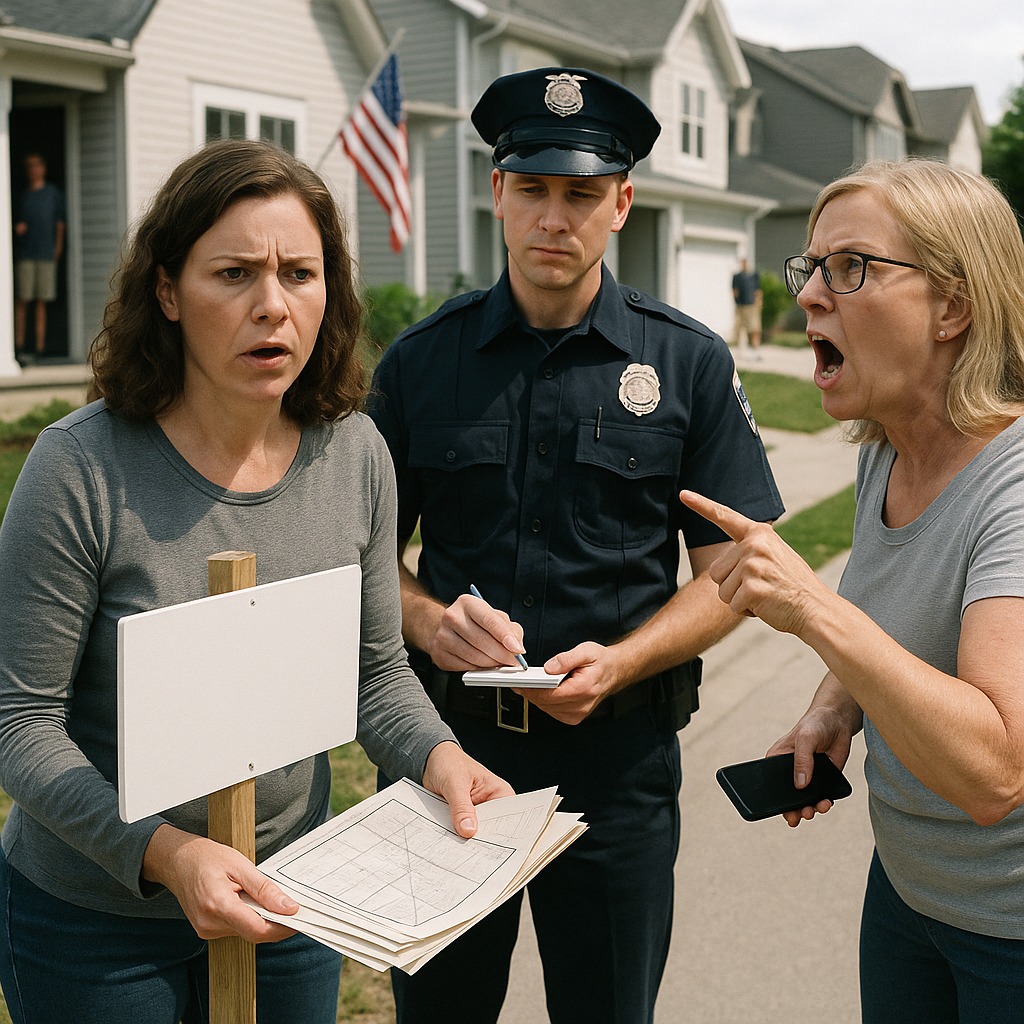
And that’s how, on a breezy, deceptively peaceful Tuesday afternoon, I ended up in the back of the cul-de-sac with sweat on my neck, dirt on my boots, and a brand-new sign in my hands—
just as the HOA’s loudest enforcer came around the corner and dialed 911 on me for trespassing.
On my own land.
