
My Parents Called My Daughter’s Surgery “NOTHING SERIOUS” Then They Told Her In Her Hospital Bed “YOU SHOULD HAVE DIED INSTEAD, YOU’RE BAD FOR OUR FAMILY ANYWAY”. She Was 13 Years Old Recovering From Surgery. I Made One Call Restraining Order Filed And…
Part 1
Tuesday evenings in our house are usually loud in the normal way. Homework spread across the kitchen table, the dog nosing around for crumbs, my daughter Lily narrating her day like she’s a sports commentator. I’d been halfway through making spaghetti when the front door opened and she didn’t say a word.
She just stood there.
Her backpack slid off one shoulder and hit the floor with a soft thud. Her face was the color of paper. One hand pressed hard into her lower right side, fingers curled like she was trying to hold something in.
“Mom,” she said, and her voice was small, which is how I knew it wasn’t a normal complaint. Lily could be dramatic about math tests and cafeteria food. This wasn’t that. “Something’s really wrong.”
I wiped my hands on a dish towel and came around the counter. “Hey. Okay. Where does it hurt?”
She tried to answer and a sound came out instead—half breath, half whimper. When I touched her stomach, barely a brush, she screamed like I’d stabbed her.
That scream did something to my whole body. It yanked every thought into a single straight line: hospital, now.
I grabbed my keys, my purse, and the sweatshirt she’d shrugged off the chair and shoved it at her. The dog started barking because dogs know when something is wrong. Lily bent forward as we walked, moving like every step shook her insides.
The emergency room lobby smelled like disinfectant and stale coffee. The chairs were full, the TV in the corner murmuring about weather, and a toddler was crying in a way that sounded exhausted rather than angry. I checked Lily in at the front desk and the nurse took one look at her and said, “Wheelchair.”
Lily’s pain was so sharp she couldn’t sit upright. Her forehead was damp. Her lips were pale. When they rolled her back, the wheels squeaked faintly and I couldn’t stop staring at her sneakers, at the way her feet barely moved as if she might float away.
They put her in a room and the staff moved fast. Blood draw. Blood pressure cuff. Thermometer. Questions Lily tried to answer between breaths. The doctor was calm in that practiced way that always makes me feel like the floor is either stable or about to collapse.
Within an hour, he came back with a CT scan on his tablet and the kind of face people wear when they want to soften a cliff before they show you the drop.
“Appendicitis,” he said. “It’s about to rupture. We need to operate immediately.”
My heart did a strange thing—like it tried to beat and forgot how.
“She’s thirteen,” I said, which was stupid. Appendixes don’t care how old you are.
“I know,” he said gently. “But if we don’t operate now, she could become septic. It can be life-threatening. We’re already seeing signs it’s progressing.”
They handed me forms. Consent. Risks. Anesthesia. All the words you don’t want to read when your kid is curled up on a hospital bed holding her belly and biting her lip so hard it’s turning white.
Lily looked at me with glassy eyes. “Mom,” she whispered.
“I’m right here,” I said. I kissed her forehead and tasted sweat. “I’m not going anywhere.”
They wheeled her out and the hallway swallowed her, bright lights and swinging doors. Her hair was in a loose ponytail and the strap of her hospital gown slid down her shoulder, making her look even smaller. She called my name once before the doors closed.
I stood there for a second too long, staring at the blank door like it might open and give her back.
The surgery was supposed to take an hour.
It took three.
I sat in the waiting room with my legs bouncing hard enough to shake the chair. I watched an old man do a crossword puzzle. I listened to someone else’s phone conversation about a work meeting like the world was still normal. I tried not to imagine Lily on an operating table with strangers holding her body open.
When the surgeon finally came out, his scrubs were clean, his expression tired.
“It started to rupture,” he said. “We caught it, but it was close. There was infection. We cleaned it out. She’s stable now, but she’ll need IV antibiotics and observation.”
Relief hit first—hot and dizzy. Then fear came right behind it, like a shadow catching up.
“Can I see her?”
“In a little bit,” he said. “Recovery first.”
I sat back down and realized my hands were shaking so hard my wedding ring rattled against the armrest. I hadn’t called anyone. I hadn’t eaten. I hadn’t even looked at my phone since the last update.
And that’s when I called my parents.
Not because I needed them, exactly—though some small, stubborn part of me still wanted them to show up like parents are supposed to. But because Lily loved them. Because she had a picture of her and Grandpa in her room from when she was seven, both of them holding fish at a lake, smiling like the world was safe. Because she still believed they were a solid thing in her life.
My mom answered on the third ring.
“Hello?”
“Mom. It’s me.” My voice sounded thin, like it came from someone else. “Lily’s in the hospital. She had emergency surgery.”
A pause.
“What kind of surgery?” she asked, like she was asking what kind of tires I’d bought.
“Appendicitis. It ruptured. They had to operate immediately. It was… close.”
Another pause, longer.
“Is she alive?” my mom asked.
“Yes,” I said, stunned. “Yes, she’s alive.”
“Then it’s fine,” my mom said, as if that ended the conversation. “You’re being dramatic. It’s not that serious.”
I blinked hard. “Mom. Her appendix ruptured. The doctor said if we’d waited—”
“But you didn’t wait,” she cut in. “So what’s the problem?”
“The problem is my daughter just had major surgery,” I said, and my voice started to rise. “She’s thirteen. She’s scared. I thought you’d want to know.”
“We do know,” my mom said. “You just told us.”
“Are you coming?” I asked. “To the hospital?”
She sounded genuinely confused. “Why would we do that?”
I looked around the waiting room—people holding each other, people talking softly, nurses walking by with purpose—and felt something tilt inside me.
“Because Lily is your granddaughter,” I said slowly. “Because she might want to see you. Because she almost—”
My dad’s voice clicked onto the line. He’d picked up the other phone in their house, the one they still used like it was 1998.
“Rachel,” he said, and my name sounded like an accusation. “Your mother’s right. This isn’t a big deal. You always overreact.”
“She’s not fine,” I said. “She’s in pain. She’s—”
“We’re not driving two hours for an appendix,” he said flatly. “Call us when it’s actually serious.”
Then they hung up.
I sat there staring at my phone like it had betrayed me. Like the screen might light back up and say, sorry, wrong parents, try again.
And then I stood up, because Lily was still in a hospital bed without anyone but me. And whatever my parents had become, I wasn’t going to let that leak into her room.
Part 2
When Lily came out of recovery, she looked like she’d been wrung out and folded into herself. Her eyes were heavy and unfocused. A clear tube ran from her arm to a bag of antibiotics. There were bandages on her belly, neat and small, like the world was pretending the inside of her hadn’t almost turned into poison.
I sat beside her bed and smoothed her hair back. She smelled like hospital soap and plastic.
“It hurts,” she whispered.
“I know,” I said. “They’re going to manage it. You’re safe.”
Her eyelids fluttered. “Did Grandma and Grandpa… do they know?”
My throat tightened. “They know.”
“Are they coming?” she asked, and the hope in her voice was so pure it made me angry in a way that wasn’t fair. Not at her. At the world. At them.
“They couldn’t make it tonight,” I said. “But they’ll call.”
Lily nodded, accepting it with the easy trust of someone who hadn’t learned yet how adults can fail you.
The next day was a blur of nurses checking vitals, doctors explaining infection levels, and Lily alternating between sleeping and waking in discomfort. She was brave, in the way kids are brave because they don’t have a choice. She asked for ice chips. She watched cartoons on her phone. She tried to laugh at a joke and winced halfway through.
My parents didn’t call.
I told myself they were busy. I told myself my mom had gotten flustered. I told myself all the excuses I’d told myself my whole life because accepting the truth felt like swallowing glass.
On day two, the doctor said the infection was worse than they’d thought. Lily needed at least another day of IV antibiotics and monitoring.
Lily looked at me with watery eyes. “I want to go home.”
“I know,” I said. “Soon. We’re just making sure your body’s okay.”
I stepped out for ten minutes to grab coffee and a granola bar that tasted like cardboard. I was standing in line when my phone buzzed with a text from the nurse.
Your parents are here visiting Lily.
My brain didn’t process it at first. It felt like reading the wrong message on the wrong day.
Then my stomach dropped.
I left my coffee on the counter and ran.
I ran down the hall with my badge flapping against my chest. I ran past a janitor pushing a cart, past a nurse with a clipboard, past a family clustered around a vending machine.
When I reached Lily’s room, the door was half open.
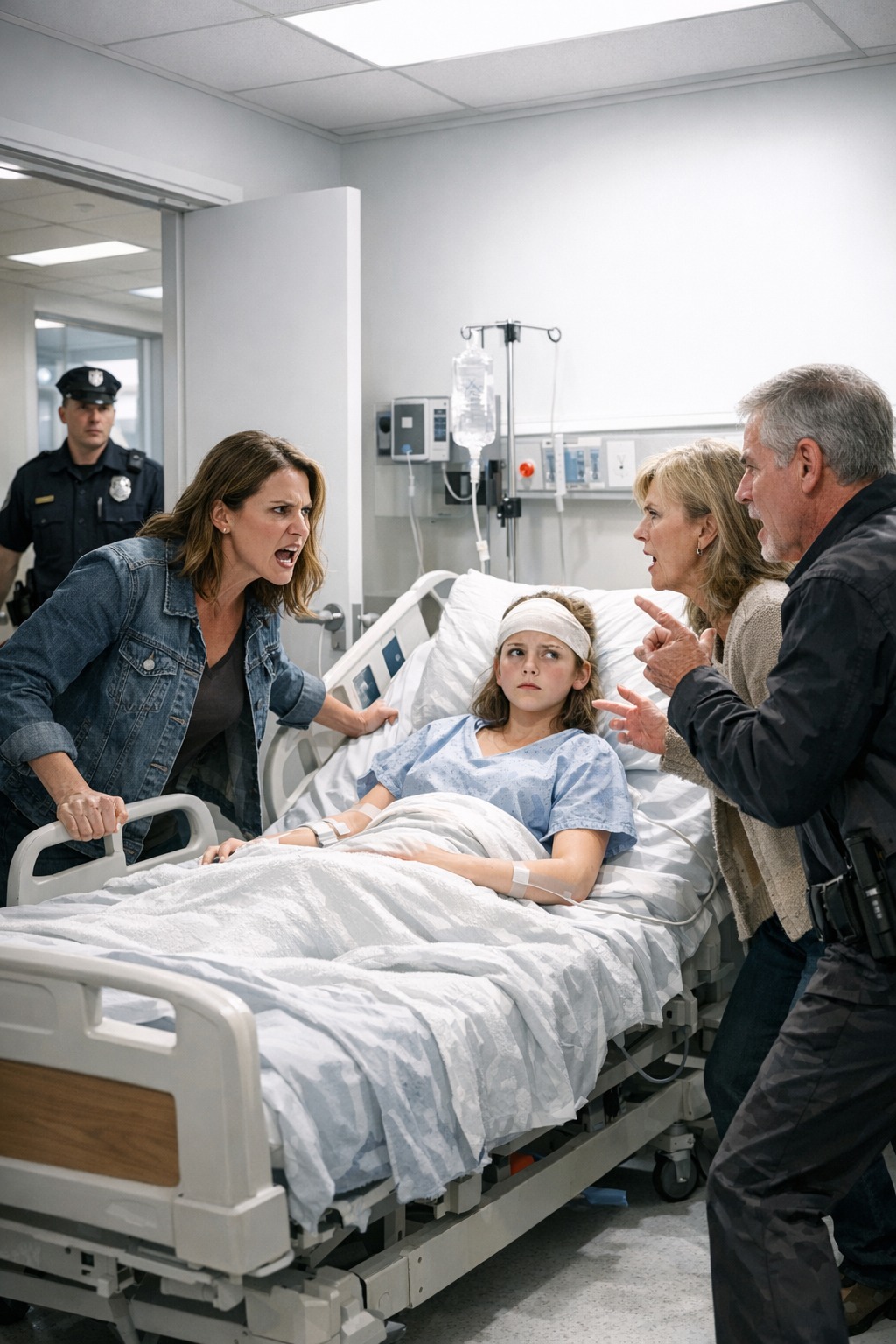
My mom and dad stood on either side of Lily’s bed like they belonged there. Lily looked startled, but there was happiness in her face too—like a flower turning toward sun even after someone keeps stepping on it.
Grandma!” she said, voice weak but bright.
My mom smiled, and it was her performance smile. The one she used at church and PTA meetings. The one that made strangers think she was sweet.
“Well, you look fine,” she said to Lily. “See? I told your mother this wasn’t serious.”
Lily’s face faltered. “It was pretty serious,” she said carefully. “The doctor said my appendix almost exploded.”
My dad made a dismissive sound. “Doctors always exaggerate. Makes them seem more important.”
I stepped in. “Hi,” I said, and my voice sounded too calm for how fast my heart was pounding.
My mom didn’t even look at me at first. She sat on the edge of the bed like she owned it. “Lily, sweetie, we need to talk to you about something.”
Every alarm bell in my body went off.
“Mom,” I said, stepping closer. “Not now.”
She ignored me like I was a fly.
“Lily,” she said, “your mother tells us you’ve been seeing a therapist.”
Lily glanced at me, eyes nervous. “Yeah,” she said quietly. “For my anxiety.”
My mom nodded slowly, as if she were confirming a suspicion. “And that’s been going on for how long now?”
“Almost a year,” Lily murmured.
My dad crossed his arms. “That’s what we thought.”
I moved between them and the bed, not touching, just placing my body as a shield. “You need to leave.”
My mom blinked like she couldn’t believe I’d spoken. “Rachel, don’t be ridiculous. We’re having a conversation with our granddaughter.”
“You’re upsetting her,” I said. “She just had surgery. Get out.”
My dad’s face hardened. “We drove two hours. We’re not leaving until we say what we came to say.”
Then say it and leave,” I said, my voice tight.
My mom looked directly at Lily, and I watched my daughter’s face—still soft with pain medication—tilt toward her like she was waiting for comfort.
My mom took a breath and said, “Lily, honey, you need to understand something. Your anxiety, your depression, all of this mental illness stuff… it’s very hard on your mother.”
I felt cold spread through me.
“It’s hard on all of us,” my mom continued, still in that calm voice like she was reading a recipe. “You’re only thirteen. You shouldn’t be this much work.”
Lily’s eyes filled fast. “I’m trying,” she whispered.
My dad nodded. “She’s right. And honestly, Lily, when we heard about the surgery, we thought maybe it would be better if…”
He paused.
“If what?” I demanded.
He looked at Lily, not me. “If you hadn’t made it.”
The room went silent in a way that felt unreal, like sound had been sucked out through a vent.
Lily’s face crumpled. “What?” she breathed.
My mom leaned in as if she were being kind. “If the surgery had gone wrong,” she said, “it would have solved a lot of problems. You’re very difficult, Lily. You’re expensive. You’re bad for this family.”
Lily made a sound I’d never heard from her before—broken, stunned, grief coming out as a sob that didn’t know where to go.
Something in me snapped clean.
I didn’t scream. I didn’t cry. I moved.
I grabbed my mother’s forearm and pulled her away from the bed with a force that surprised even me. “Get out,” I said, and my voice wasn’t mine. “Get out right now, or I’m calling security.”
My dad started, “Rachel—”
I pointed at the door. “Out. Now.”
My mom looked offended, like I’d spilled wine on her dress. My dad looked irritated, like I’d interrupted an important TV show.
They walked out.
Lily folded into herself and sobbed into her pillow, shaking like she was freezing. I climbed onto the edge of the bed and wrapped her up as best I could around the IV lines and the soreness.
She clung to me. “Why do they hate me?” she gasped.
“They don’t get to decide your worth,” I said, pressing my lips to her hair. “They are wrong. They are wrong. They are wrong.”
But Lily kept crying, and in between sobs she whispered, “Are they right? Am I bad? Would everyone be better without me?”
That was the moment something hardened inside me into a decision.
When Lily finally fell asleep, exhausted and medicated and wrecked, I stepped into the hallway and made one phone call.
Not to my parents.
To my lawyer.
Part 3
I was divorced, which meant I already had a lawyer’s number saved under a name that made me feel both relieved and ashamed. The divorce hadn’t been dramatic so much as slow—years of realizing I was doing everything alone, years of trying to keep a marriage intact while my ex drifted away like he was waiting for the tide to carry him somewhere easier.
My parents had hated my ex, of course, but not because he was absent. They hated him because he didn’t play their game well enough. He didn’t smile correctly. He didn’t say the right things. He didn’t make my mother feel like the most important person in the room.
I’d learned early that their love came with conditions. Be pleasing. Be easy. Be quiet. Don’t embarrass us. Don’t be needy. Don’t be complicated. Don’t be human in a way that requires work.
Lily, with her big feelings and anxious spirals and honest questions, was everything they didn’t know how to pretend to accept.
My lawyer answered on the second ring. “Rachel?”
“I need you,” I said. My voice sounded calm, which was the weirdest part. Like my body had decided panic was a luxury we couldn’t afford. “My parents said something to Lily in her hospital room. Something unforgivable.”
There was a pause. “Tell me.”
I told her. Every word. The sentence about it being better if Lily hadn’t made it. The way my mother said Lily was bad for the family. The way Lily cried like her world had cracked open.
My lawyer didn’t interrupt. When I finished, she said, quietly, “Okay. We’re going to document this. We’re going to protect Lily. And we’re going to build a paper trail that makes it impossible for them to claim any right to access her.”
“I want no contact,” I said. “Completely.”
“Done,” she said. “We’ll start with a formal cease-and-desist. We’ll notify the hospital staff if they return. We’ll notify the school. And if they violate it, we pursue a restraining order.”
A nurse came down the hall and asked if everything was okay. I nodded and forced a smile. I hung up and walked back into Lily’s room.
She slept with her mouth slightly open, cheeks damp from crying. I sat beside her and watched the slow rise and fall of her chest like it was the only thing holding me to earth.
When she woke later, she was quiet. Too quiet.
She stared at the TV without seeing it. She picked at her blanket. When I offered her a sip of water, she took it like she was doing it to make me feel better.
“Sweetheart,” I said softly.
She flinched, then forced herself to look at me. “Are you mad at me?”
My heart broke in a very specific way—like a glass shattering and still being useful enough to cut.
“No,” I said. “Never. I’m mad at them. I’m mad at anyone who would say that to you.”
Lily swallowed. “I didn’t mean to be difficult.”
“You are not difficult,” I said, and I made my voice firm. “You are a kid who’s been through a lot. Your feelings are not a crime. Your anxiety is not a moral failure. And you are not too much.”
She didn’t argue. She just looked at me with a kind of disbelief, like she didn’t know if she was allowed to accept kindness.
That night, after the nurse adjusted her IV, Lily whispered, “Do you think they wished I died?”
I didn’t lie. I didn’t soften it in a way that would make her question her own reality.
“I think they said something cruel,” I answered. “And I think cruelty says more about them than it ever will about you.”
The next morning, I asked the hospital to flag Lily’s file so my parents couldn’t visit without my explicit consent. The charge nurse didn’t blink. She’d heard enough stories in her life to know that “family” sometimes meant “threat.”
When my parents called my phone that afternoon, I didn’t pick up. I let it ring until it went to voicemail.
Then I saved the voicemail.
My mom’s voice was irritated. “Rachel, this is ridiculous. Call us back. We need to talk. You embarrassed us in front of hospital staff. Lily needs to understand we were only trying to help.”
I forwarded it to my lawyer.
Over the next two weeks, the legal process moved like a machine. Not fast, exactly, but steady. My lawyer filed a no-contact order request and attached a sworn statement from me. I wrote down exactly what happened, where it happened, who was present, and how Lily reacted.
I asked the nurse who’d texted me about my parents visiting if she would be willing to provide a brief statement confirming they were in the room during the incident. She agreed.
The hospital security log showed the time they arrived and left.
Documentation is a strange comfort. It doesn’t erase harm. But it draws a line in ink that says: this was real, and it matters.
When Lily was discharged, she walked slowly, hunched a little, clutching a pillow to her abdomen like it was armor. The fall air outside the hospital smelled like wet leaves. Lily blinked in the sunlight like she’d been underground.
At home, she slept a lot. She watched comfort shows. She ate crackers and broth. She let me sit beside her on the couch like I was part of her healing.
Her therapist, a kind woman Lily trusted, met with her twice that week and helped her name what happened: emotional abuse. Betrayal. Cruelty. Not truth.
That language mattered. Because Lily’s brain, like many anxious brains, wanted to make a pattern. It wanted a rule that explained pain: if someone hurt me, I must deserve it. If someone leaves, it must be my fault.
We built new rules instead.
People can be wrong.
People can be cruel.
Cruelty is not a measure of your worth.
Two weeks after the hospital, the no-contact order was granted. It wasn’t dramatic. It was a judge reading paperwork and signing a document. But to me it felt like a door being installed in a house that had never had one.
I sent copies to Lily’s school. I met with the principal. I explained that my parents were not allowed to pick Lily up, not allowed to visit, not allowed to contact her through staff. The principal didn’t ask for gossip. She asked for the order and promised compliance.
For a while, there was silence.
It was a new kind of silence—soft instead of tense. The phone didn’t ring with guilt calls. No surprise visits. No performative apologies.
Lily began to breathe again.
One afternoon, a month later, she sat at the kitchen table doing homework and said, without looking up, “We’re better off without them.”
My throat tightened. I went to the sink and pretended I was washing dishes so she wouldn’t see my face.
Because she was right.
