

While I was away on a trip my brother made my 14-year-old daughter leave my parents’ house and she ended up waiting alone on the sidewalk. WWhen I called them in shock my mom calmly said “You and your daughter simply don’t belong here anymore” that moment I quietly stopped covering her loan payments and household bills now they’re panicking because the bank has started foreclosure proceedings on their home… And soon they may have nowhere to live
Part 1
My phone rang at 2:14 a.m., and I answered on the first buzz because something in me already knew.
Three states away, half-dressed for an early client meeting, I sat up in a hotel bed and said, “Maya?”
My daughter didn’t speak at first. I heard wind, a thin shiver of sound like the world was too open around her. Then my screen filled with a photo she’d sent: her backpack on cold concrete, the streetlight casting a hard circle of yellow, and behind it—my parents’ house, all dark windows and closed curtains.
She was outside.
My fourteen-year-old was outside at 2:14 a.m.
“Maya, where are you?” I asked, like my eyes weren’t already screaming the answer.
“On the sidewalk,” she said, voice too steady. That steadiness broke my heart more than crying would’ve. “Uncle Brian told me to leave.”
I swung my legs out of bed so fast my ankle caught the suitcase and the pain didn’t even register. “Put me on video,” I said. “Right now.”
The call switched. The camera was shaky at first—gloved hands, the strap of her backpack, then her face, pale under a streetlight. She’d pulled her hoodie tight, hair tucked into it like she was trying to become smaller.
Her eyes looked dry.
“Mama,” she said, as if she was the one comforting me.
My throat tightened so hard it hurt. “Where are Grandma and Grandpa?”
“In the house,” she said. “They said it’s not their problem.”
I felt something go quiet in my chest. Not numb. Steel.
“Hand me to them,” I said.
Maya turned the camera toward the front steps and walked closer. Each step sounded too loud in the empty night. When she knocked, the door cracked open a few inches. Warm light spilled out, and my mother’s face appeared—my mother, Sharon Caldwell, hair perfectly brushed even at two in the morning, expression composed like she was answering a neighbor’s question about garbage pickup.
She didn’t look past Maya to the sidewalk. She didn’t ask if Maya was cold.
“Marissa,” she said into the phone, tone brisk. “What is it?”
“What is it?” I repeated, my voice shaking now. “My daughter is outside in the middle of the night. Why is my daughter outside?”
My mother exhaled like I’d asked her to do math. “Brian said she was being disrespectful. She was taking up space. He’s got work in the morning. We can’t have drama in the house.”
“She’s fourteen,” I said. “It’s two fourteen in the morning.”
My mother’s face stayed calm. “You and your daughter simply don’t belong here anymore,” she said, like she was discussing the weather.
I stared at her through the screen. I wanted to scream. I wanted to threaten. I wanted to reach through the phone and shake the woman who raised me.
Instead, I heard myself ask one question, quiet and deadly.
“Are you refusing to let her in?”
My mother didn’t hesitate. “Yes.”
Behind her, I heard another voice—Brian’s, my older brother’s, muffled but clear enough.
“Tell her to stop babying the kid,” he said. “Maybe now she’ll get the message.”
I watched my daughter’s face in the corner of the screen. She didn’t flinch. She just swallowed, hard, like she was forcing herself not to cry on camera.
That was the moment I made the decision that terrified them, even though they didn’t know it yet.
Not revenge. Not rage.
Consequences.
“Maya,” I said, turning my voice gentle because she deserved softness even if no one else did, “stay on video with me. Don’t move. If anyone approaches you, you tell me immediately.”
She nodded.
Then I did not argue with my mother.
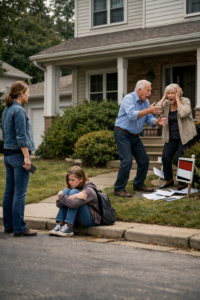
I booked the earliest flight home with shaking hands and a clarity that felt like ice water. I called a neighbor from my contacts—Mrs. Delaney, the woman who’d watered my plants when I’d been hospitalized once, the woman my family called “nosey” because she asked questions.
She answered on the second ring, sleepy and startled.
“Marissa?” she whispered.
“My daughter is locked out of my parents’ house,” I said. “She’s on the sidewalk. Can you go get her right now?”
There was a pause, then a sharp inhale. “I’m going,” Mrs. Delaney said. “Stay on the phone.”
For the next forty-seven minutes, I watched Maya through grainy video. I watched her shift her weight from foot to foot, arms wrapped around herself. I watched her pretend she wasn’t scared. I watched the empty street, every passing car a threat.
“Maya,” I said softly, “talk to me. Anything.”
She gave me the smallest smile. “You’re going to be mad,” she said.
“I’m not mad,” I told her, and it was the truth that surprised even me. “I’m clear.”
At 3:02 a.m., headlights swept over Maya’s face. Mrs. Delaney’s car rolled to the curb, and she climbed out in a bathrobe and winter boots like she’d walked into an emergency without hesitation. She wrapped Maya in a blanket, then marched to my parents’ front door and banged on it.
I couldn’t hear what Mrs. Delaney said, but I saw my mother open the door wider. I saw my mother’s mouth move, stiff and defensive. I saw Mrs. Delaney step closer, eyes blazing, and point at Maya like she was a witness.
Then the door opened fully, and Maya stepped inside, still wrapped in Mrs. Delaney’s blanket.
My daughter didn’t look back at the street.
I cried silently in a hotel room while my child walked into the house where she’d just been thrown out.
By 5:30 a.m., I was in an airport security line with my laptop bag, jaw clenched, eyes burning, my entire body running on adrenaline and one steady thought:
If this is how they treat my child, I am done protecting them from consequences.
I landed before sunrise.
Maya was on my couch when I walked into my apartment, wrapped in one of our blankets, pretending to sleep so she wouldn’t cry again. She looked smaller than she should have in the dim morning light, like someone had stolen a piece of her and she hadn’t figured out how to ask for it back.
I sat beside her and didn’t touch her right away. Some silences don’t need words. They need presence.
My phone buzzed on the coffee table.
A family group chat message.
My mother: Did you send the usual payment yet? The mortgage pulls today.
I stared at the words until the world narrowed down to one simple fact I’d avoided naming for years.
For years, I had quietly held up their entire life.
And they had just put my child on the street anyway.
