

Part 1
I’m a firefighter. My life is built around moving toward the thing everyone else is escaping.
When the pager goes off at three in the morning, you don’t get to be fragile. You don’t get to spiral. You pull on your boots, you check your gear, and you go. You trust the people beside you with the kind of trust that has weight. You learn discipline, because panic is contagious. You learn calm, because the world is always louder than you want it to be.
For a long time, I thought my relationship with Jessica ran on the same principles.
Jessica and I met at a charity 5K my department hosted. She wore a bright smile and an expensive watch and asked me questions like my answers mattered. She said she loved first responders. She said she admired men who served. She said the right things with the ease of someone who’d practiced them in a mirror.
I didn’t see the practice. I saw the warmth.
We moved fast. Too fast. She filled my small house with scented candles and throw pillows and little upgrades I never asked for. She talked about our future like it was already planned: wedding, bigger home, vacations, kids. When she said it, it sounded like a promise.
When she spent money, it sounded like confidence.
I’m not wealthy. I’m steady. I bought my house young because I worked overtime and didn’t blow my checks. I drive a paid-off truck. I keep an emergency fund because fires don’t ask if you’re prepared. Jessica treated a credit card like a magic wand and acted offended when the spell didn’t work forever.
The argument that lit the match started the way it always did: small and sharp.
She sat at my kitchen table scrolling through car listings, eyes bright. “This one,” she said, turning the screen toward me. “It’s perfect. And the payments won’t even be that bad.”
I glanced at the number and felt my stomach drop. “Jess, that’s more than my mortgage.”
She rolled her eyes. “It’s an investment. People take you seriously when you drive something serious.”
“I’m a firefighter,” I said. “People take me seriously when I show up.”
She tapped the screen again. “All I need is you to co-sign. Then the rate drops. Easy.”
I took a slow breath. I’ve pulled people out of cars twisted like metal origami. I’ve watched a house collapse while we were still inside it. I’ve learned when something is already too far gone.
“No,” I said. Calm. Logical. Final.
Her face changed. Not into anger. Into something colder. Like a switch flipped behind her eyes and the warmth was never really there.
“You’re controlling,” she snapped. “You’re cheap. You’re selfish.”
“I’m responsible,” I said. “And I’m not tying my name to a loan you can’t afford.”
She stood so fast her chair scraped the floor. “You don’t get to decide what I deserve.”
“I get to decide what I sign,” I replied.
That’s when she grabbed the vase.
It was heavy glass with a soft blue tint, a gift from my grandmother before she passed. It sat on a shelf in the living room, one of the few things in the house that felt like history.
Jessica held it up with both hands like she was presenting it. Then she threw it against the wall.
It exploded. A thousand pieces glittered across the hardwood. For a second, the sound hung in the air and my brain couldn’t match it to reality.
“What are you doing?” I asked, voice low.
She turned toward me with a strange look on her face. Not regret. Not shock. A smirk, like she’d just made a move in a game and expected applause.
Then she lifted her arm and raked her fingernails down her own skin. One clean line. A thin bead of blood.
My body went cold.
“Get out of my house!” she screamed, and her voice changed on purpose. It took on a tremble that sounded like fear but didn’t reach her eyes. “Get out!”
I stared at her. “My house,” I said quietly. “This is my house.”
“Not for long,” she hissed.
She pulled out her phone and dialed 911.
I didn’t move. I stood there watching her perform, because my brain kept insisting this couldn’t be happening. She spoke to the dispatcher like she’d rehearsed it: sobbing, breathless, terrified.
“He got violent,” she cried. “He threw a vase at me. He grabbed me. Please, please send someone. I’m scared.”
The lie was so big it had gravity. It pulled the room into a new shape.
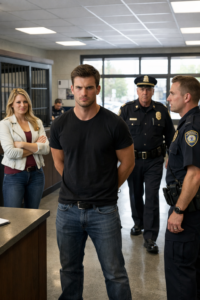
When the officers arrived, they saw exactly what Jessica wanted them to see: broken glass, a crying woman, a fresh scratch, and a man twice her size standing there silent and stunned.
In situations like that, protocol becomes a machine. They separated us. One officer spoke gently to Jessica like she was a delicate thing. The other asked me questions in a clipped tone, eyes already made up.
I tried to explain, but you can’t outtalk a staged scene in the first five minutes. Not when you’re the bigger body in the room.
“Sir,” the officer said, “turn around.”
The click of handcuffs is a sound I’ll never forget. Metal on metal. Final and wrong.
As they guided me toward the patrol car, Jessica stepped onto the porch.
Her tears were gone. Her face was calm. She leaned in close enough that I smelled her perfume and whispered so only I could hear.
“Have fun in jail, loser.”
Then she smiled like she’d just won a prize.
At the station, they put me in a small processing room that smelled like bleach and old coffee. They took my belt and my shoelaces. They read my rights like they were reciting a script. They told me I had one phone call.
Jessica’s whole plan rested on one arrogant assumption: that I was alone.
She’d met my father a few times. She knew he was a cop. She thought he was some old-timer with a desk job, a guy who’d done his time and now counted down to retirement.
She didn’t know his name mattered.
My father’s name is Robert Williams. My name is Matt Carter. I took my mother’s maiden name when I was eighteen because I didn’t want to live in the shadow of the most powerful cop in the city. I wanted to build a life that belonged to me.
My relationship with him has always been complicated. Pride, distance, love buried under years of not saying the right things.
But sitting in that room with my wrists cuffed and my life tilted sideways by a lie, I didn’t call a lawyer first.
I called my dad.
