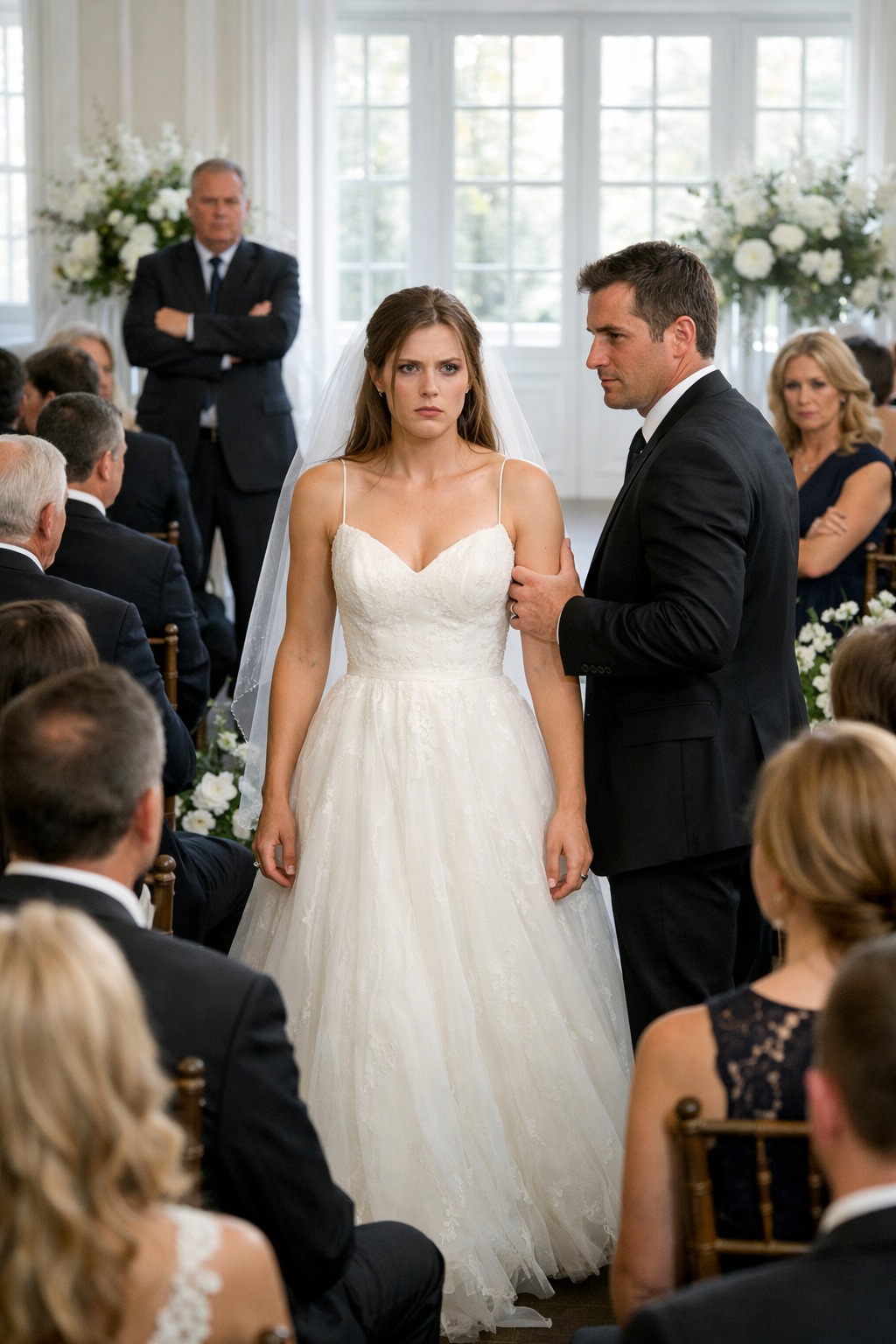

The Aisle Was Empty Beside Me. My Dad Refused To Walk Me, Because My Stepmom Said I Was “Stealing Her Daughter’s Spot.” The Music Started. Everyone Turned To Look At Me Alone. I Took A Deep Breath When Someone Unexpected Took My Arm…
Part 1
The string quartet played like nothing was wrong.
Their bows rose and fell in perfect unison, silk and horsehair drawing out a song I’d chosen months ago, back when I still believed this moment would look the way it does in movies. The melody floated through the church like light, wrapping itself around the stained-glass windows and driftwood beams.
And beside me, the aisle was empty.
I felt it more than saw it—this blank space at my right side, a hollow where my father’s arm was supposed to be. Every step in my white heels echoed louder because there was no second pair to braid with my own. My bouquet weighed a ton, even though the florist had promised it would be “light as air.”
White roses. My roses.
He’d brought them home every birthday when I was a kid. Wrapped in cheap paper, tucked into a grocery bag, their petals always a little bruised from the ride. He’d hand them to me with a grin and say, “For my Lydia. The prettiest girl at the party.”
They smelled different now.
Funny thing about walking alone down a church aisle: the flowers that once meant comfort now just smelled like grief.
People turned as I passed. A soft rustling ran through the pews, lace and chiffon and expensive perfume shifting with every whispered question.
“Where’s her dad?”
“I thought he was walking her…”
“Is he okay? Is he—”
“He’s sick,” I’d told the few who asked earlier. “It was sudden. He really wanted to be here.”
Lies glide easier than tears, especially when your makeup artist charged more than your first month’s rent.
The truth was harsher, simpler, and so much harder to hold:
He refused.
He refused to walk me down the aisle because my stepmother told him I was stealing her daughter’s moment. As if love was a finite resource and I’d taken more than my share.
I forced my gaze forward, toward the altar where Ethan waited, nerves written in the way he kept tugging his cufflinks. His eyes met mine, and he smiled—soft, steady, the kind of smile that said I’ve got you even when everything else is shaking.
I smiled back. For him. For the cameras. For the strangers who would see these photos one day and never know what was missing just outside the frame.
The quartet reached the swell of the song. My fingers tightened around the stems, thorns biting the inside of my palm, grounding me.
Halfway down the aisle, I felt it: a buzz against my hip.
I’d tucked my phone into a hidden pocket in the seam of my dress, “just in case,” even though I couldn’t have said what “case” I was planning for. Nerves. Vendor emergencies. Something.
I hadn’t planned for this.
The vibration persisted. I shifted the bouquet just enough to slide a thumb along the side of the phone, lighting up the screen.
One new message.
From: Dad.
We need to talk.
Four words. I’d seen them a thousand times from clients, from contractors, from professors back in college. They always meant something was broken, delayed, disappointing.
Seeing them from him, now, as I walked alone toward the altar he’d chosen not to share with me, almost made my knees buckle.
I didn’t stop. Couldn’t. The aisle was a tunnel, and at the end of it was my future. I kept moving, one foot in front of the other, heart beating louder than the music.
But I glanced over my shoulder.
For a split second, I let myself hope he’d be there—bursting through the doors, tie askew, eyes shining with “I was wrong, I’m here, I’m sorry.”
The heavy wooden doors stayed shut.
No dramatic entrance. No last-minute change of heart.
Just me, the music, and an empty stretch of aisle where a father should have been.
A strange calm rolled through me.
Maybe, I thought, the empty space was trying to tell me something. Maybe it was a reminder I’d been ignoring for years.
When no one stands beside you, stand taller.
My mother’s voice, from another lifetime.
I straightened my shoulders and walked.
But to understand how I ended up here—in a church filled with flowers and whispers, my father on the other side of a text message instead of at my side—we have to go back.
Back to when I was sixteen, and the world I knew started quietly rearranging itself around a woman named Patricia.
Dad met her at a real estate gala.
At least, that’s the story he told: he’d been working late, forced to attend some networking event with too much champagne and not enough food. He’d been standing by the raw bar, contemplating the life choices that had led him to be surrounded by men in shiny suits comparing commission checks.
And then she’d walked in.
Patricia.
Even before I met her, I knew the look he got when he talked about her. A kind of sheepish glow, like a teenager describing his crush. He said her name too often in one sentence. He lingered on details like the way she laughed or how her jacket had matched the color of the hotel’s carpet “in this weirdly satisfying way.”
The night he introduced us, he’d cleaned the house top to bottom, fussing over throw pillows like they were part of the first impression.
“Lydia,” he said, straightening a picture frame that hadn’t been crooked. “This is important. Just… be nice, okay?”
I was sixteen. “Be nice” sounded suspiciously like “don’t be yourself,” but I swallowed the retort and nodded.
Patricia arrived ten minutes late in a cloud of expensive perfume.
She was polished. That’s the first word that came to mind. Everything about her gleamed: her pearls, her patent heels, her hair the color of honey spun smooth. She had the kind of smile that landed on people like a spotlight and the kind of laugh that made men lean closer.
She hugged Dad like they’d been doing it forever.
“And this must be Lydia,” she said, turning to me with a smile that almost reached her eyes. “I’ve heard so much about you.”
I wanted to ask, Oh yeah? Like what?
Instead, I shook her hand. Her fingers were soft, manicured, with a ring that could have paid for my entire college fund.
“Nice to meet you,” I said.
She looked around our small living room as if assessing it for resale value. Her gaze snagged on the photos lining the mantel—me at five in a tutu; Dad and me at the county fair; Mom, laughing into the camera, sunlight in her hair.
That last photo made her expression flicker.
“She was beautiful,” Patricia said.
“She was,” my father replied, voice quiet.
My chest tightened.
My mother had been gone for three years by then. Cancer. Fast and brutal. I’d watched Dad crumble and rebuild into something smaller, more cautious, like the grief had sanded off all his sharp edges.
Part of me wanted him to be happy. Another part still belonged to the girl who used to crawl into bed between her parents on Sunday mornings, all tangled limbs and shared cartoons.
Patricia filled the kitchen that night with easy conversation and compliments that tasted like artificial sweetener—sweet, but leaving a strange aftertaste.
She laughed at everything Dad said, touching his arm just a second too long.
Six months later, her toothbrush lived next to his.
Eight months later, she moved in “officially,” her boxes lining the hallway like a second, prettier family had been shipped to our door.
“I know it’s an adjustment,” Dad told me, standing outside my bedroom door. “But Patricia is… she’s good for me, Lyd. She makes things feel lighter.”
“What does she make me?” I asked.
He winced. “She wants to get to know you. She has a daughter too, you know. You girls are close in age. It’ll be good. You won’t be so alone.”
He said it like a blessing. It sounded like a sentence.
Her daughter arrived the following weekend.
Haley.
She was fifteen, a year younger than me, with soft brown hair and eyes that always seemed on the verge of tears or laughter—nothing in between. She wore clothes that fit perfectly, not just in size but in sense: coordinated, delicate, the kinds of outfits you saw in catalogs.
“Hi,” she said, chewing her lip. “I like your posters.”
I glanced back at my room, where band flyers and architecture sketches fought for wall space.
“Thanks,” I said. “I like your manicure.”
She smiled, looking down at her pale pink nails. “My mom insists,” she said. “I’d rather be painting murals, but shh, that’s a secret.”
We weren’t instant best friends. We weren’t enemies either.
We were two girls suddenly sharing a bathroom and a father-shaped pillar in the middle of our lives.
The problems didn’t start with Haley.
They started with Patricia.
Her parenting style arrived in stages, like a renovation no one had consented to.
First came the small comments.
“Do you really want to wear that shirt, Lydia? It hides your figure.”
“Such a strong voice you have. Maybe soften it a bit in front of guests. Men don’t like being talked over.”
“Haley, sweetheart, that dress is perfect on you. Lydia, maybe next time something less… loud?”
Fatigue made me bite my tongue. I told myself I was imagining the edge under her words, the way she’d say “Lydia” and “ladylike” in the same sentence like one canceled out the other.
Then came the comparisons.
“Haley finished her homework before dinner. How about you, Lydia?”
“Haley offered to help with the dishes. It would be nice if you’d step up too.”
“Your father is so worried about you, sweetheart. Haley’s already thinking about colleges with good husband prospects. You still don’t even know what you want to do.”
Architecture, I thought. I want to build things. But I’d stopped saying it out loud after Dad’s offhand comment at breakfast: “That’s a tough field, pumpkin. Very competitive. Maybe something more practical?”
“Like what?” I’d asked.
He’d opened his mouth, but Patricia had cut in, all helpful smiles.
“She’s young, dear,” she’d said. “She’ll grow out of these whims.”
These whims.
My dreams.
I kept my sketches in a notebook under my mattress after that.
Sometimes, Haley would knock on my door and flop onto the bed to gossip about school or show me a new drawing. Patricia never seemed to mind her messes the way she minded mine.
“You’re so creative,” she’d say, fixing Haley’s hair with gentle fingers. “You get that from me.”
If I walked into the room, the praise would stop. Patricia’s eyes would drag over me like I was a scuff on hardwood.
“You’re leaving your shoes by the door again, Lydia,” she’d say. “It’s important to treat a home with respect.”
Once, I heard my name like a slap through the thin walls.
“She’s just jealous,” Patricia said.
I’d gone to the kitchen for water; footsteps and hushed voices had stopped me just before the doorway. I froze.
“Jealous?” Dad’s voice. “Of what?”
“Of Haley,” Patricia replied, exasperation curling around the words. “Of us. You give her too much freedom. She’s sixteen and you let her talk to you like you’re equals. She needs boundaries.”
“She’s my daughter,” he said. His voice cracked on the word.
“Exactly,” Patricia snapped. “And she’s using that to manipulate you. She’s trying to take what’s Haley’s. Her time. Her place. Her father.”
I slid down the hallway wall, my back pressed against the cool paint.
Manipulate. Take.
Words I’d never imagined hearing about myself in his voice.
He didn’t defend me again in that conversation. He didn’t say, “That’s not who she is,” or “She’s still grieving her mom.”
He just said, quietly, “I’ll talk to her.”
That night, he didn’t knock on my door.
When I was younger, he used to peek in before bed with a goofy wave. “Night, kiddo. Love you big as the sky.”
That night, and so many after, the hallway stayed dark.
No soft knock. No sky-sized love.
Just silence.
