

“STOP BEING SO DIFFICULT!” They’d Yell At Family Dinners. “IT’S ALL IN YOUR HEAD!” But After I Collapsed At My Sister’s Graduation Party The Emergency Room Visit Changed Everything. When The Doctor Showed Them The Test Results… BUT…
Part 1
“Just eat it, Olivia. Stop being so dramatic.”
My mom pushed the plate toward me like she could shove the problem into my mouth and make it disappear. Shrimp pasta. Creamy sauce. The smell hit the back of my throat and my body reacted before my brain could argue with it.
That familiar tightness crept in, like someone was slowly drawing a string around my windpipe.
Everyone else at the table looked perfectly comfortable. My dad twirled noodles with the confidence of a man who’d never had to fear dinner. My sister Kate sat back in her chair, already wearing the bored expression she saved for my “food thing.” My brother Mike was there too, quiet at the end of the table, looking like he wished he were anywhere else.
I was twenty-four, and somehow I still felt like a kid under a microscope whenever my family decided to make a point.
“Mom, please,” I said, keeping my voice low. I slid the plate away with my fingertips like it was a live wire. “You know seafood makes me sick.”
Kate rolled her eyes so hard it looked like it hurt. “Oh, here we go again. Your mysterious reactions.”
“I’m not making it up,” I said.
“You ate fish sticks all the time when we were kids,” she snapped.
“That was before,” I started, but Dad cut in.
“Enough,” he said, voice sharp. “Your mother spent hours cooking. The least you could do is show some appreciation.”
My cheeks burned. I stared down at my empty plate, trying not to cry because crying would turn into evidence for their favorite argument: Olivia’s dramatic again.
It wasn’t just discomfort. It never had been. Certain foods made my throat tighten, my stomach cramp, my skin flush hot and blotchy, my head spin like I’d been spun in circles. Sometimes I threw up for hours. Sometimes I lay in bed shaking, exhausted and scared, wondering if this would be the time my body finally took it too far.
But my family didn’t see those nights. I’d learned to hide them. It was easier than listening to them laugh about my “food drama.”
The worst part was they were right about one thing: I hadn’t always been like this. The reactions started when I was sixteen, like someone flipped a switch. At first it was shellfish. Then dairy. Then nuts. Then a list so long I started writing it down just to keep track.
The more the list grew, the more my family decided it had to be my fault.
Mom sighed like I was ruining her life. “Fine. I suppose you want your special plain chicken and rice again, like a child.”
Before I could answer, Kate jumped in, eager. “She’s doing it for attention. Remember last month when she claimed she was allergic to the birthday cake at my engagement party?”
I remembered. I also remembered lying in the bathroom that night sweating and shaking, trying not to make noise so nobody would accuse me of performing.
Dad reached across the table and put a small portion of pasta on my plate.
“Just try a bite, princess,” he said, like he was being kind. “This picky eating has gone on long enough.”
My heart started racing. The smell alone made my throat feel smaller. I could already feel the beginnings of that pressure behind my sternum, the warning flare my body sent out.
“I can’t,” I whispered, standing up. My chair scraped the floor loud enough that Mom’s eyes flashed. “I’m sorry, but I can’t.”
“Sit down,” Mom snapped. “You’re twenty-four, for heaven’s sake. This is ridiculous.”
I remained standing, hands clenched so tight my fingernails bit my palms. “What’s ridiculous is none of you believe me. I’ve told you for years something’s wrong, and you won’t listen.”
Kate smirked. “We listen. We listen to your new food drama every single week. Last month it was dairy. Before that nuts. Now seafood. What’s next, air?”
At the end of the table, Mike cleared his throat. His voice was quieter than the rest of us, but it carried.
“I’ve noticed she gets really red and blotchy after certain foods,” he said. “Maybe we should—”
“Don’t encourage her,” Mom cut him off. “She’s perfectly fine.”
Dad nodded. “This is like when she was convinced she had chronic fatigue in college. Remember that?”
I remembered that too. I remembered a campus doctor suggesting allergy testing, and my parents waving it away like it was a scam. “She’s stressed,” Mom said then. “She just needs to sleep more.”
The shrimp pasta sat on my plate like a dare. The way everyone watched me made my stomach twist. Years of their disbelief had planted seeds in my own mind. Maybe I was exaggerating. Maybe anxiety was doing this. Maybe I’d trained myself to panic at certain foods.
Maybe.
My hand trembled as I picked up the fork.
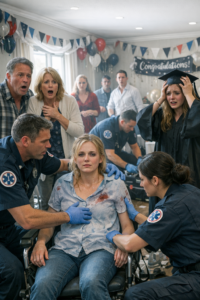
Mom’s expression softened into victory before I even took the bite, like she could already imagine telling her friends about how she cured me.
Kate leaned forward, eyes bright, ready to win.
Dad watched with the patience of a man expecting a lesson to land.
Mike looked uneasy, his gaze flicking between my face and the plate.
I took a tiny bite. Barely a forkful.
The reaction was immediate.
My throat tightened hard, not gradually, not politely. Hard. Like a door slamming shut. Heat flooded my face. My tongue felt thick. The room tilted.
“See?” Mom said, proud and relieved at the same time. “Nothing happened.”
I tried to speak. To tell them something was very wrong. But no words came out. Air wouldn’t move the way it should. My chest pulled in a desperate, shallow attempt to breathe around the tightening.
My vision blurred at the edges. A roaring filled my ears like distant ocean waves.
Mike’s chair scraped back.
“Her face,” he said, voice rising in alarm. “Look at her face.”
Kate’s smile fell.
Dad’s brows knitted together.
Mom stood, suddenly not triumphant anymore. “Olivia?”
I reached for the table to steady myself, but my fingers slid on the glossy surface like my body didn’t know how to coordinate anymore. My legs went soft. The room spun faster.
The last thing I remember was the sound of Mike’s voice, sharp and urgent.
“Call 911! Now!”
Then everything went black.
Part 2
I woke up to bright lights and the steady beep of a monitor keeping time with my heart.
For a second I didn’t know where I was. The air smelled like antiseptic. My mouth was dry. My throat burned like I’d swallowed sandpaper. Something was taped to my arm, and when I tried to move, a tug reminded me there was an IV.
Mike sat beside my bed, elbows on his knees, staring at his hands like he’d been holding himself together by force. When he saw my eyes open, his whole face shifted into relief so intense it hurt to look at.
“Hey,” he said softly. “Hey, Liv.”
My voice came out as a whisper. “What… happened?”
He squeezed my hand. “You had a severe allergic reaction. The paramedics used two EpiPens in the ambulance.”
Two. The number landed heavy and cold.
“If we’d waited any longer,” he continued, voice thickening, “they said—”
He stopped. He didn’t finish the sentence. He didn’t need to.
In the hallway outside my room, I could hear raised voices. My parents. A nurse’s calm reply. My mom’s voice cracked with panic.
A doctor came in a moment later, followed by my parents. They looked like they’d been emptied out. My mom’s face was pale and blotchy from crying. My dad’s jaw worked like he was chewing on regret. Kate trailed behind them, eyes swollen and red, like she’d cried too but maybe also like she didn’t know where to put herself.
“Miss Mitchell,” the doctor said, glancing at my chart. She looked to be in her forties, hair pulled back, expression serious in a way that didn’t soften when she saw my parents. “I’m Dr. Patel.”
She pulled up something on a tablet and her gaze flicked over it quickly. “We have your initial test results back, and I need to talk to you about what we’re seeing.”
My heart rate picked up, and the monitor beeped faster like it was worried with me.
Dr. Patel continued, voice clear. “You have one of the most severe cases of multiple food protein intolerance syndrome I’ve seen, combined with several life-threatening allergies.”
My mom sank into a chair like her knees gave up. “That can’t be right,” she whispered. “She was fine as a child.”
“FPIES and severe allergies can develop at any age,” Dr. Patel said, not unkind, but firm. “Based on what Olivia described and what we’re seeing, her symptoms began in her teens. The fact that this wasn’t investigated earlier is concerning.”
Dad shifted, uncomfortable. “We thought she was just… particular about food.”
Dr. Patel’s eyebrows lifted. “These test results show severe reactions to shellfish, dairy, and nuts, among other proteins. This is not being particular. These reactions can be fatal.”
The word fatal hung in the air like smoke.
I watched my family’s faces as the truth landed. I’d imagined this moment for years—someone in authority finally saying I wasn’t making it up. I thought I’d feel victory.
Instead, I felt tired. Like my body had spent years screaming and only now had someone decided to listen because it screamed loud enough to nearly stop.
Dr. Patel turned the tablet toward my parents. “Her blood work shows significant inflammation markers. Her body has been under constant stress from repeated exposure to trigger foods. I’m concerned about long-term damage.”
My mom started crying again, softer this time, like she couldn’t stop.
Kate stared at the tablet and then at me like she was seeing me for the first time.
“We’re going to run comprehensive allergy panels,” Dr. Patel continued. “For now, Olivia must carry two EpiPens at all times. You’ll need strict avoidance of trigger foods and a careful elimination diet. Cross-contamination is a major risk.”
“I’ve basically been doing that already,” I rasped. My throat felt raw, but the words came out anyway. “When I was allowed to.”
My mom’s breath hitched, like she’d been punched.
Dad’s eyes dropped.
Mike didn’t let go of my hand.
Dr. Patel nodded once, like she respected the blunt truth. “Going forward, Olivia will need her family’s full support. This condition requires careful management. One mistake can be catastrophic.”
A nurse came in to adjust my IV drip and checked the monitor. “Your anaphylactic response was severe,” she said gently. “We’re keeping you under observation at least twenty-four more hours.”
Kate chose that moment to step closer. “Olivia, I’m so sorry,” she said, voice shaking. “I had no idea.”
I looked at her and felt something complicated swell in my chest. Not just anger. Not just relief. A mixture of old hurt and new boundaries forming.
“You did have an idea,” I said quietly. “You just didn’t believe it mattered.”
Kate’s face crumpled.
Dr. Patel glanced between us and then spoke, practical again. “I’m having the nurse bring educational packets about FPIES and anaphylaxis. I strongly recommend the whole family reads them and takes a training course on EpiPen use and food safety.”
When the doctor left, the room filled with a heavy silence. The monitor beeped. The air conditioner hummed.
My mom finally spoke, voice small. “Why didn’t you push harder? Why didn’t you insist on seeing a doctor?”
For a second I thought I misheard. The question hit me like a slap.
“I did,” I said, disbelief sharpening my tone. “For years. You told me I was being dramatic. You told me it was all in my head. You forced me to eat foods that made me sick because you didn’t believe me.”
Dad opened his mouth. “We didn’t know—”
“You didn’t want to know,” I cut in, and the truth tasted bitter. “It was easier to blame me than admit something might actually be wrong.”
My voice trembled, and the monitor beeped faster like it was tattling on my emotions.
“Do you know how scary it is,” I continued, “to feel your throat closing while your own family tells you you’re faking it?”
Mike squeezed my hand, a warning to slow down, but I couldn’t stop.
“The doctor said I could have died tonight,” I said. “If Mike hadn’t called 911, I could’ve died at your dinner table while you told me to stop being dramatic.”
That landed. My mom sobbed openly now. Dad looked like someone had drained ten years out of him. Kate stared at the floor.
A nurse poked her head in. “Everything okay? Her heart rate is elevated.”
Mike straightened, protective. “We’re done for now,” he said, looking pointedly at our parents. “She needs rest.”
They filed out slowly, each one looking devastated in a different way.
When the door closed, I finally let myself cry. Not because I felt sorry for them. Because I felt sorry for the sixteen-year-old version of me who’d been begging to be believed.
And because I didn’t know what came next now that the truth was undeniable.
