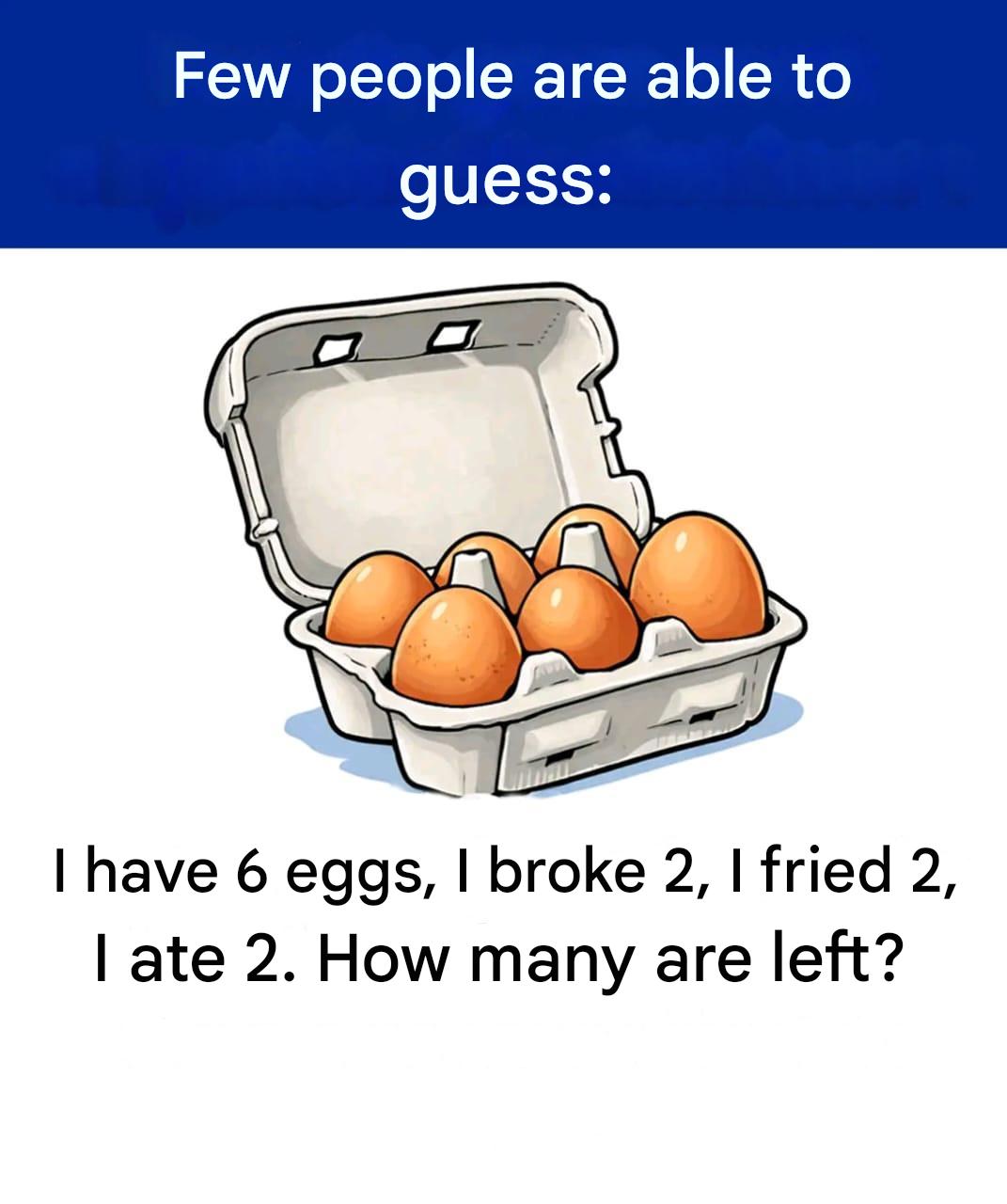

Simple, right? Yet, as soon as you start thinking about it, your brain starts to hesitate. Some people respond instinctively, others reread the sentence several times, convinced there's a trick somewhere. And they're right: it all depends on how you interpret the actions.
Why is this puzzle so confusing?
This type of challenge works because it leverages our automatic responses. Our brains like to work quickly, especially when the numbers are small and the actions are familiar. In this case, we mentally add and subtract… without always taking the time to analyze whether the actions involve the same objects.
And that's precisely what makes this viral logic puzzle so effective: it doesn't test your calculation skills, but your ability to read carefully and think methodically, rather than hastily.
The trap hidden in the words:
Many people assume that broken, fried, and eaten eggs are all different. Following this reasoning, two eggs would be broken, two more fried, two more eaten… which gives the impression that almost nothing remains.
But the riddle never specifies that these are eggs.
