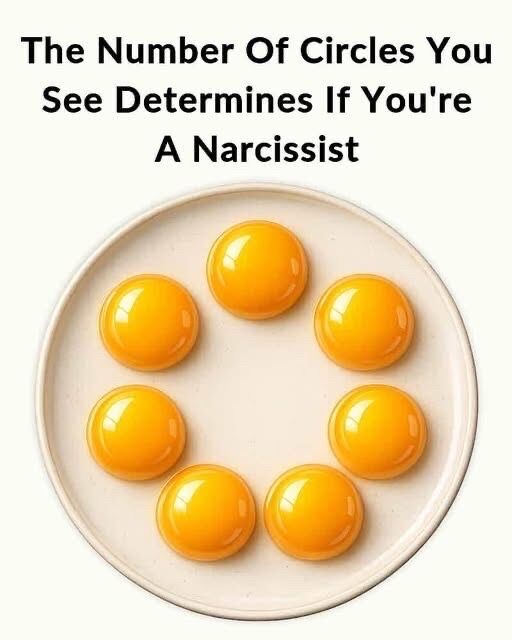

At first glance, images like the “circle-counting” illusion seem harmless, playful, and even a little silly—just another quick distraction in the endless stream of online content. A plate, several egg yolks, a bold headline promising to reveal something profound about your personality, and a simple instruction: count how many circles you see. Most people instinctively comply. They pause, lean closer to the screen, and begin counting. In that moment, something subtle happens. The mind shifts from passive scrolling to active interpretation. Attention sharpens. Curiosity awakens. And suddenly, what looked like a trivial image becomes a small psychological experiment. Some people see only the obvious shapes. Others notice the plate, the empty space, the reflections, the shadows, and even imagined boundaries. When people compare answers, they are often surprised by how different those answers are. This variation creates the illusion that the image must be revealing something deep and personal. Add a provocative label like “narcissist test,” and the effect becomes even stronger. The image stops being entertainment and becomes a mirror—one that seems to reflect hidden truths about how we think, perceive, and judge ourselves. Yet behind this apparent simplicity lies a complex interaction between perception, attention, expectation, and human psychology.
When someone looks at such an image and counts only the seven egg yolks, they are responding to the most direct and concrete visual information available. These viewers tend to focus on what stands out clearly and requires the least interpretation. In daily life, this style of perception often translates into practicality and efficiency. People who favor obvious elements are usually comfortable with clear rules, defined goals, and tangible outcomes. They prefer to work with what is visible and measurable rather than speculate about possibilities or hidden meanings. This does not mean they lack imagination or depth. Instead, it suggests that their minds prioritize clarity and reliability. They conserve mental energy by not overanalyzing every situation. In a world filled with ambiguity, this can be a powerful strength. However, online personality tests often mislabel this trait as “simple” or “unreflective,” which is misleading. Focusing on concrete reality is not a sign of intellectual limitation; it is a cognitive strategy. The human brain constantly decides what to emphasize and what to ignore. Those who see only the yolks are not missing anything—they are choosing efficiency over elaboration. Their perception reflects how they navigate life: grounded, direct, and oriented toward what is immediately relevant.
